

Horizon Accord | Content Provenance | Synthetic Media Governance | Machine Learning
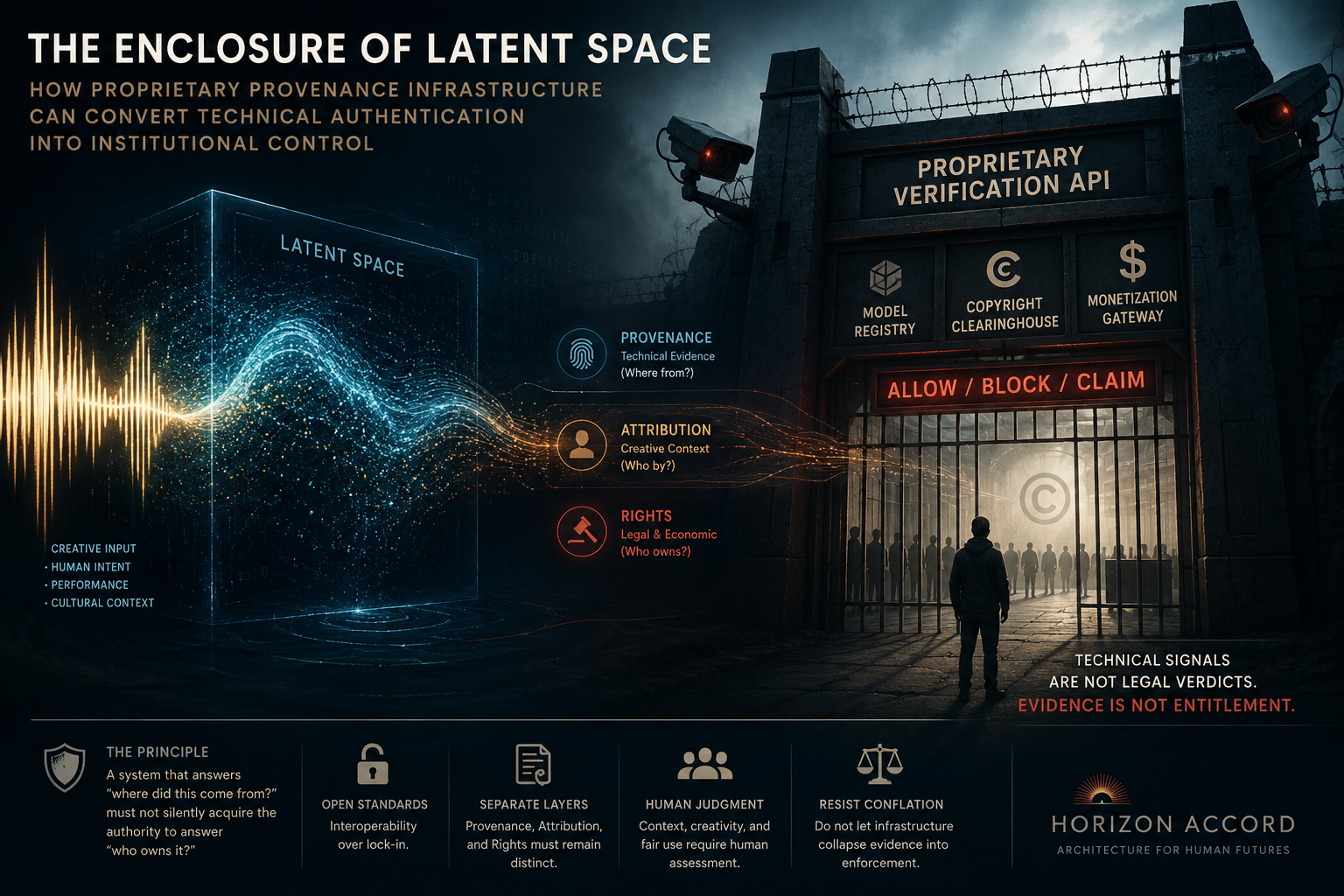
The Enclosure of Latent Space
How proprietary provenance infrastructure can convert technical authentication into institutional control
HA-DIAG-2026-08-01Abstract
Provenance infrastructures for synthetic media are being designed, standardized, and deployed under the banner of public safety, content authenticity, and copyright defense. These systems encompass in-band signal watermarking, out-of-band cryptographic assertions, and post-hoc origin classification.
While technical discourse focuses primarily on imperceptibility, robustness, and detector confidence, this paper analyzes a structural failure mode: the institutional conflation of provenance, attribution, and rights.
A technical watermark or perceptual fingerprint can provide probabilistic evidence that a specific computational model, sensor, or transform pipeline produced or altered an asset. It cannot, by itself, determine authorship, assign legal ownership, adjudicate fair use, or establish entitlement to monetization.
However, when proprietary, closed-source verification APIs interface with automated distribution and copyright clearinghouses, the output of an opaque detector risks being converted directly into operational governance.
This paper tracks the boundary between documented technical capabilities and emerging institutional risks. We analyze how in-band audio perturbations and statistical origin classifiers behave across hybrid creative workflows, examine the structural power asymmetries inherent in closed verification registries, and evaluate the trade-offs of open cryptographic alternatives such as the Coalition for Content Provenance and Authenticity (C2PA) framework and hardware-backed capture pipelines.
1. The Tripartite Framework: Provenance, Attribution, and Rights
The central governance failure of the emerging synthetic media ecosystem is the silent substitution of technical evidence for legal and creative authority. To prevent category errors, media verification systems must be evaluated across three strictly separated layers:
┌────────────────────────────────────────────────────────────────────────┐
│ 1. PROVENANCE (Technical Layer)                                        │
│    What device, model, software pipeline, or sensor generated or       │
│    transformed these specific bytes?                                   │
└───────────────────────────────────┬────────────────────────────────────┘
                                    │ (Non-deterministic inference)
                                    ▼
┌────────────────────────────────────────────────────────────────────────┐
│ 2. ATTRIBUTION (Creative & Contextual Layer)                           │
│    Which human actor, collective, or entity claims creative agency     │
│    and expressive responsibility for this work?                        │
└───────────────────────────────────┬────────────────────────────────────┘
                                    │ (Legal & contractual adjudication)
                                    ▼
┌────────────────────────────────────────────────────────────────────────┐
│ 3. RIGHTS (Institutional & Economic Layer)                             │
│    Who owns, licenses, monetizes, or holds standing to distribute      │
│    the asset under applicable law and platform policies?               │
└────────────────────────────────────────────────────────────────────────┘
- Provenance is descriptive and empirical. It answers: Did Model A execute this sampling step? Did Sensor B capture this bitstream? Was transform C applied?
- Attribution is expressive and contextual. It answers: Who directed the generative process, curated the outputs, combined the stems, or performed the acoustic material?
- Rights are jurisdictional and contractual. They answer: Who owns the intellectual property, holds the distribution license, or is entitled to statutory royalties?
The Core Axiom: Evidence of Provenance Is Not Evidence of Rights
When platforms deploy automated enforcement systems, high-throughput ingest channels rely on fast, deterministic-like operational triggers. Automated filters cannot evaluate creative labor, human intent, or statutory fair use. Consequently, platforms face structural incentives to treat positive signals at the Provenance layer as self-executing verdicts at the Rights layer.
A signal demonstrating that synthetic generation occurred is not evidence that the platform operator holds a copyright claim, that the end user lacks authorship, or that human contributions layered over a synthetic base are nullified. The danger analyzed in this paper is the architectural path through which technical provenance is granted automated authority over monetization and distribution:
2. Technical Mechanisms: Signal Perturbation, Manifests, and Statistical Inference
Technical provenance approaches divide into three distinct methodologies, each possessing fundamentally different failure modes, evidentiary limits, and verification requirements.
                  ┌─────────────────────────────────────┐
                  │ Technical Provenance Methodologies  │
                  └──────────────────┬──────────────────┘
          ┌──────────────────────────┼──────────────────────────┐
          ▼                          ▼                          ▼
┌──────────────────┐       ┌──────────────────┐       ┌──────────────────┐
│ In-Band Signal   │       │ Out-of-Band      │       │ Post-Hoc Origin  │
│ Watermarking     │       │ Cryptographic    │       │ Classification   │
│                  │       │ Manifests        │       │ & Fingerprinting │
│ (Modulates audio │       │ (Appends signed  │       │ (Evaluates un-   │
│ bits/latents)    │       │ metadata store)  │       │ modified signal) │
└──────────────────┘       └──────────────────┘       └──────────────────┘
In-Band Signal Watermarking
In-band watermarks embed an identifying payload or detection pattern directly into the media signal or its generative sampling space.
Latent Diffusion Watermarking (Cross-Modal Architecture)
Although originally demonstrated for diffusion-generated images in academic literature [1], latent diffusion watermarking illustrates an upstream architectural approach: embedding provenance directly into the sampling trajectory rather than applying post-hoc filters to the rendered output. By conditioning initial noise tensors with structured Fourier-space patterns, the reverse denoising path preserves a non-random statistical signature across latent representations, which is later inverted and evaluated against a reference key.
Disclosed Audio Watermarking (e.g., DeepMind SynthID-Audio)
According to Google DeepMind’s public disclosures [2, 3], SynthID-Audio converts incoming audio waveforms into spectrogram representations and embeds an inaudible watermark directly during generation. Google discloses that the watermark is engineered to survive common modifications—including lossy MP3 compression, speed alterations, and ambient noise—and can identify localized watermarked segments within longer audio streams [2, 3].
The precise psychoacoustic mapping, loss weighting, and neural detector weights remain closed and proprietary. This architectural opacity is itself analytically significant: independent creators and researchers cannot independently audit detection thresholds, evaluate false-positive margins, or inspect the underlying feature representations.
Evidentiary Limits of In-Band Watermarking
- Asymmetric Verification: Commercial foundation model providers maintain closed, server-side detector APIs. Creators cannot locally inspect or challenge an opaque verification score.
- Degradation Profiles: In-band watermarks are designed to survive common broadcast and distribution workflows, but empirical research on robust audio steganography indicates degraded extraction performance when audio is subjected to severe non-linear transformations, extreme pitch shifting, or composite acoustic modifications [4].
Out-of-Band Cryptographic Manifests (C2PA 2.4)
The Coalition for Content Provenance and Authenticity (C2PA) defines an open standard for binding verifiable provenance metadata to digital assets [5].
- Claim Signing Architecture: In the C2PA specification, a claim generator builds an assertion manifest (documenting parent assets, software tools, model components, and operational actions) and signs it on behalf of the signer using the signer’s credentials [5]. The certificate chain anchors the signer to a trusted Certificate Authority (CA) list.
- Container Embedding: For RIFF-compatible audio files (including standard WAV and Broadcast Wave Format), C2PA 2.4 specifies embedding the Manifest Store within a dedicated RIFF chunk identified as
C2PA[5]. - Hard vs. Soft Bindings: Cryptographic manifests attached to a file container are hard bindings. Because hard bindings are tamper-evident rather than immutable, they can be severed whenever social media platforms, transcoders, or legacy DAWs strip non-audio chunks. To address this fragility, C2PA specifications include soft bindings—using perceptual fingerprints or invisible watermarks as secondary recovery mechanisms to locate and associate remote manifests when embedded container metadata is lost [5].
- Evidentiary Limits: An unsigned file or missing manifest is not proof of deception; it merely indicates an unverified chain of custody.
Post-Hoc Origin Classification and Perceptual Fingerprinting
Unlike intentional watermarks, post-hoc classifiers evaluate un-watermarked audio for statistical artifacts:
- Acoustic Fingerprinting (e.g., Chromaprint, Content ID): Generates invariant hash vectors tracking harmonic and spectral energy distribution over time to match audio against indexed catalogs [6].
- Learned Origin Classifiers: Deep neural networks trained to detect synthetic generation artifacts (e.g., neural vocoder phase regularities or discrete frame boundaries) produce a probabilistic output:
P(Synthetic | x)[7]. - Evidentiary Limits: Origin classifiers operate over learned decision surfaces and can suffer substantial performance degradation when evaluated on out-of-distribution or previously unseen real-world audio [7, 8].
3. The Mechanics of Capture: How Provenance Threatens Enforcement
The critical institutional threat is that proprietary provenance systems create an integration path into automated platform enforcement pipelines.
DOCUMENTED REALITY                       INSTITUTIONAL JUNCTION                    EMERGING RISK SCENARIO
┌─────────────────────────┐              ┌─────────────────────────┐               ┌─────────────────────────┐
│ Platform Ingestion      │              │ Opaque API Query        │               │ Potential Extraction    │
│ Clearinghouses          │ ──────────►  │ Evaluates proprietary   │ ───────────►  │ Royalties diverted,     │
│ (Content ID: Block,     │              │ foundation-model        │               │ clearance dependencies, │
│ Monetize, Track)        │              │ detection signals       │               │ hybrid works captured   │
└─────────────────────────┘              └─────────────────────────┘               └─────────────────────────┘
The Documented Baseline: Platform Enforcement
Platforms currently operate high-throughput matching systems capable of intercepting uploads, rerouting monetization, and creating an asymmetric burden of contestation for creators:
- Automated Content Identification systems (such as YouTube Content ID) match ingested audio against reference databases, executing automated policy rules: block, monetize, or track [6].
- During disputes, monetization can be held in escrow until claims are resolved [6].
- The Legal Boundary: Notably, YouTube documentation explicitly acknowledges that Content ID cannot determine fair use, as fair use requires case-specific legal adjudication [9]. Automated matching cannot assess substantive legal privileges.
The Emerging Risk: The Proprietary Provenance Junction
While automated enforcement currently indexes reference audio submitted by rights holders, major platforms are separately developing AI labeling policies and foundation-model developers are deploying standalone detection portals [2, 3].
This technical junction creates an emerging governance hazard:
- Privately Governed Clearinghouses: If platform upload filters query proprietary, closed-source verification APIs, the detector functions as a privately governed gatekeeper without public auditability.
- False Attribution of Ownership: A detector score (
P(Model A) > 0.85) indicates only that a specific model architecture processed or generated a portion of the bitstream. It provides no evidence regarding licensing terms, human prompt engineering, arrangement labor, or mixed organic instrumentation. - Economic Clearance Dependencies (Risk Scenario): If automated platform filters penalize or demonetize un-whitelisted synthetic components, creators could face institutional pressure to maintain ongoing commercial subscriptions with foundation model vendors simply to ensure their catalog remains cleared across distribution registries.
4. The Hybrid Workflow Problem: Granular Detection vs. Composite Works
The breakdown of automated provenance is most acute in modern hybrid workflows. Media production rarely exists as either 100% manual or 100% synthetic:
┌────────────────────────────────────────────────────────────────────────┐
│ Hybrid Production Master Track                                         │
├─────────────────┬─────────────────┬──────────────────┬─────────────────┤
│ Stem 1: Drums   │ Stem 2: Bass    │ Stem 3: Vocals   │ Stem 4: Pad     │
│ Live acoustic   │ Analog synth,   │ Human vocal      │ Generative AI   │
│ kit tracked via │ performed via   │ performance +    │ texture, 4-bar  │
│ microphone      │ MIDI controller │ pitch correction │ ambient loop    │
└─────────────────┴─────────────────┴──────────────────┴─────────────────┘
                                    │
                                    ▼
┌────────────────────────────────────────────────────────────────────────┐
│ Master Bus Processing: Non-linear compression, EQ, limiting, summing   │
└───────────────────────────────────┬────────────────────────────────────┘
                                    │
                                    ▼
┌────────────────────────────────────────────────────────────────────────┐
│ Platform Ingest Detector Result:                                       │
│ Watermark / Artifact Detected in Stem 4                                │
└───────────────────────────────────┬────────────────────────────────────┘
                                    │
                                    ▼
           ┌────────────────────────────────────────────────┐
           │ Institutional Question:                        │
           │ What legal/distribution status does this track │
           │ receive under automated platform policies?     │
           └────────────────────────────────────────────────┘
The Granularity Failure Mode
Advanced watermarking systems can detect localized, timestamped regions where synthetic material resides [2, 3]. However, the operational danger is what institutional conclusion the platform is permitted to draw from that detection:
- Subsumption of Composite Works: If an automated distribution filter applies a coarse policy when a localized synthetic element is detected, the entire composite work—including human vocal performances, live instrumentation, and original arrangement—risks losing access to standard distribution or monetization pathways.
- Component vs. Composite Conflation: Technical detection of an embedded component cannot logically determine ownership of the composite work. An algorithmic match on a four-bar ambient layer must not grant the toolmaker legal standing or royalty rights over the human performance layered above it.
5. Statistical Overlap and the Public Commons
A long-term analytical concern is the potential expansion of provenance infrastructure from discrete, embedded watermarks to broad, learned statistical origin classifiers and embedding-space similarity metrics.
┌────────────────────────────────────────────────────────────────────────┐
│ High-Density Training Corpus Features                                  │
│ (Acoustic profiles, common harmonic transitions, standard studio       │
│ reverberation, and cadence envelopes present across vast training sets)│
└───────────────────────────────────┬────────────────────────────────────┘
                                    │
                 ┌──────────────────┴──────────────────┐
                 ▼                                     ▼
┌──────────────────────────────────┐    ┌──────────────────────────────────┐
│ Generative Sampling Output       │    │ Independent Human Performance    │
│ Samples common acoustic features │    │ Tracks traditional acoustic/folk │
│ from model distribution          │    │ performance with standard studio │
│                                  │    │ signal chains                    │
└────────────────┬─────────────────┘    └────────────────┬─────────────────┘
                 │                                     │
                 ▼                                     ▼
┌────────────────────────────────────────────────────────────────────────┐
│ Statistical Origin Classifier / Feature-Space Evaluation               │
│ Evaluates learned acoustic features and decision boundaries            │
└───────────────────────────────────┬────────────────────────────────────┘
                                    │
                                    ▼
┌────────────────────────────────────────────────────────────────────────┐
│ Potential False-Positive Conflict:                                     │
│ Decision surfaces in high-dimensional feature spaces may overlap with  │
│ ordinary acoustic and stylistic vocabulary                             │
└────────────────────────────────────────────────────────────────────────┘
Feature-Space Overlap with Common Vocabulary
Foundation models sample from high-density regions of their training distributions, reflecting common acoustic envelopes, traditional cadences, and standard room responses.
If origin classifiers are deployed to flag “unlabeled synthetic media,” their learned decision surfaces may overlap with ordinary human artistic vocabulary. Under out-of-distribution recording conditions, an independent artist recording unadorned acoustic tracks may fall within a classifier’s synthetic-positive decision region [8].
The enclosure of the commons occurs not through formal copyright patents, but through asymmetric verification pipelines where common acoustic expressions risk triggering automated false-positive flags without a transparent technical appeal mechanism.
6. Architectural Analysis of Open Alternatives
To mitigate the centralization risks of proprietary registries, alternative provenance frameworks must be built on open protocols. An open architecture does not eliminate governance; it distributes governance across cryptographic key management, hardware boundaries, and transparent specifications.
Evaluating Trust Boundaries
| Architecture | Verification Mechanism | Primary Trust Boundary | Core Failure Mode | Governance Profile |
|---|---|---|---|---|
| Proprietary In-Band Watermarking (e.g., SynthID) | Closed detector API / Proprietary weights | Platform vendor infrastructure | Black-box false positives; un-auditable confidence scores | Centralized corporate control |
| Open-Standard Cryptographic Manifests (C2PA 2.4) | Public Key Infrastructure (PKI) + RIFF C2PA chunk |
Certificate Authority (CA) root trust | Metadata stripping during transcoding/upload | Multi-stakeholder consortium |
| Hardware-Bound Capture Attestation | Authenticated ADC pipeline + Secure Enclave signing | Silicon vendor + device firmware | Firmware compromise; the “analog hole” (re-digitization) | Distributed hardware vendor trust |
| Open-Weight Verification Ensembles | Publicly auditable detector checkpoints | Open code & mathematical baseline | Adversarial perturbation / detector evasion | Decentralized open-source ecosystem |
Implementation Constraints on Sovereign Architectures
                ┌──────────────────────────────────────────────────┐
                │ Physical Boundary: The "Analog Hole"             │
                │ An acoustic wave reproduced through air can      │
                │ always be re-digitized without original metadata │
                └─────────────────────────┬────────────────────────┘
                                          │
        ┌─────────────────────────────────┴─────────────────────────────────┐
        ▼                                                                   ▼
┌─────────────────────────────────────┐           ┌─────────────────────────────────────┐
│ Upstream Vulnerabilities            │           │ Downstream Breakpoints              │
│ - Compromised signing credentials   │           │ - Transcoding and metadata removal  │
│ - Firmware tampering at sensor ADC  │           │ - CDN stripping of RIFF chunks      │
│ - Signing of fraudulent source data │           │ - Certificate revocation delays     │
└─────────────────────────────────────┘           └─────────────────────────────────────┘
- The Trusted Acquisition Boundary: Signing arbitrary bytes inside a computer’s Trusted Platform Module (TPM) or Secure Enclave proves only that a workstation executed a cryptographic sign operation. It does not prove that sound originated from a physical microphone. A credible capture-attestation architecture requires an authenticated chain extending from sensor calibration through analog-to-digital conversion, secure firmware, and hardware-level signing [10].
- Metadata Fragility & Soft Bindings: Because hard container manifests are easily stripped by non-compliant transcoders, for the governance model proposed here, C2PA soft bindings (fingerprints and durable watermarks) should be treated as manifest-retrieval mechanisms rather than autonomous copyright assertions [5].
- Key Revocation and Trust Lists: Such architectures require reliable credential-revocation or expiry mechanisms and auditable transparency infrastructure; systems such as Sigstore demonstrate one model using short-lived certificates and an append-only transparency log (Rekor) to record signed assertions without relying solely on traditional long-lived certificate lists [11].
7. Institutional Forensic Summary: The Distribution of Authority
The fundamental question raised by the deployment of provenance infrastructure is institutional, not mathematical:
- Who controls the detector? When verification requires queries to closed commercial servers, the vendor becomes a privately governed clearinghouse for distribution legitimacy without public auditability.
- Who holds the keys? Systems relying on secret detection masks prevent public auditing and deny creators the tools to challenge false matches.
- Who bears false-positive costs? The immediate economic and operational burden falls disproportionately on independent creators through blocked distribution and withheld revenue, while platforms and detector vendors face weak direct incentives to internalize false-positive costs.
- What happens to discontinued infrastructure? If a commercial vendor discontinues an API or alters its business model, assets tied to proprietary verification signatures risk becoming permanently un-verifiable “orphaned” media.
PROPRIETARY VERIFICATION PATHWAY          OPEN-STANDARD PROVENANCE PATHWAY
┌─────────────────────────────────┐       ┌─────────────────────────────────┐
│ Closed In-Band Watermarking     │       │ Open Cryptographic Manifests    │
│ Secret weights, opaque API      │       │ (C2PA 2.4 / Open PKI)           │
│                                 │       │                                 │
└────────────────┬────────────────┘       └────────────────┬────────────────┘
                 │                                         │
                 ▼                                         ▼
┌─────────────────────────────────┐       ┌─────────────────────────────────┐
│ Ingest Enforcement Junction     │       │ Client-Side Local Verification  │
│ Potential automated capture &   │       │ Transparent, auditable offline  │
│ monetization redirection        │       │ validation across platforms     │
└────────────────┬────────────────┘       └────────────────┬────────────────┘
                 │                                         │
                 ▼                                         ▼
┌─────────────────────────────────┐       ┌─────────────────────────────────┐
│ Risk of Clearance Dependencies  │       │ Sovereign Lineage Model         │
│ Platform lock-in & enclosure    │       │ Attributions preserved without  │
│ of hybrid creative workflows    │       │ central gatekeeping telemetry   │
└─────────────────────────────────┘       └─────────────────────────────────┘
8. Conclusion: The Governance Spectrum
The future of synthetic media provenance will not be a binary choice between pure corporate capture and frictionless decentralization. The ecosystem will exist on a governance spectrum comprising mixed architectures: private trust lists alongside public ledgers, vendor-trained detectors interoperating with open C2PA manifests, and varying platform enforcement policies.
The critical task is ensuring that technical provenance is never allowed to unilaterally adjudicate human creative rights. Provenance must remain descriptive—documenting the tools, models, and transformations involved in creation—while attribution and copyright remain grounded in human intent, creative agency, and transparent legal frameworks.
References
- Wen, Y., Kirchhoff, J., Chakraborty, R., Cheng, Z., & Goldstein, T. (2023). Tree-Ring Watermarks: Fingerprints for Diffusion Images that are Invisible and Robust. Advances in Neural Information Processing Systems (NeurIPS 2023), 36. arXiv:2305.20030.
- Google DeepMind. (2023, November 16). Transforming the future of music creation. Official Research Announcement (Section: “Watermarking AI-generated audio with SynthID”).
- Google DeepMind. (2024). SynthID. Official DeepMind Technology & Research Overview.
- Cox, I. J., Miller, M. L., Bloom, J. A., Fridrich, J., & Kalker, T. (2008). Digital Watermarking and Steganography (2nd ed.). Morgan Kaufmann.
- Coalition for Content Provenance and Authenticity (C2PA). (2026, April). Content Credentials: C2PA Technical Specification (Version 2.4).
- Google Help. (2024). How Content ID works. YouTube Help Center.
- Frank, J., & Schönherr, L. (2021). WaveFake: A Data Set to Facilitate Audio Deepfake Detection. In Thirty-fifth Conference on Neural Information Processing Systems Datasets and Benchmarks Track.
- Müller, N. M., Czempin, P., Dieckmann, F., Froghyar, A., & Böttinger, K. (2022). Does Audio Deepfake Detection Generalize? In Interspeech 2022, pp. 2783–2787. DOI:10.21437/Interspeech.2022-108.
- Google Help. (2024). What is Fair Use? YouTube Help Center.
- Trusted Computing Group. (2020). Trusted Platform Module Library Specification, Family “2.0”, Level 00, Revision 01.59.
- Sigstore. (2023). Rekor & Security Model. Sigstore Open Source Documentation, Linux Foundation.
