The Puzzle and the Frame: Class, Race, and the Architecture of Expendability
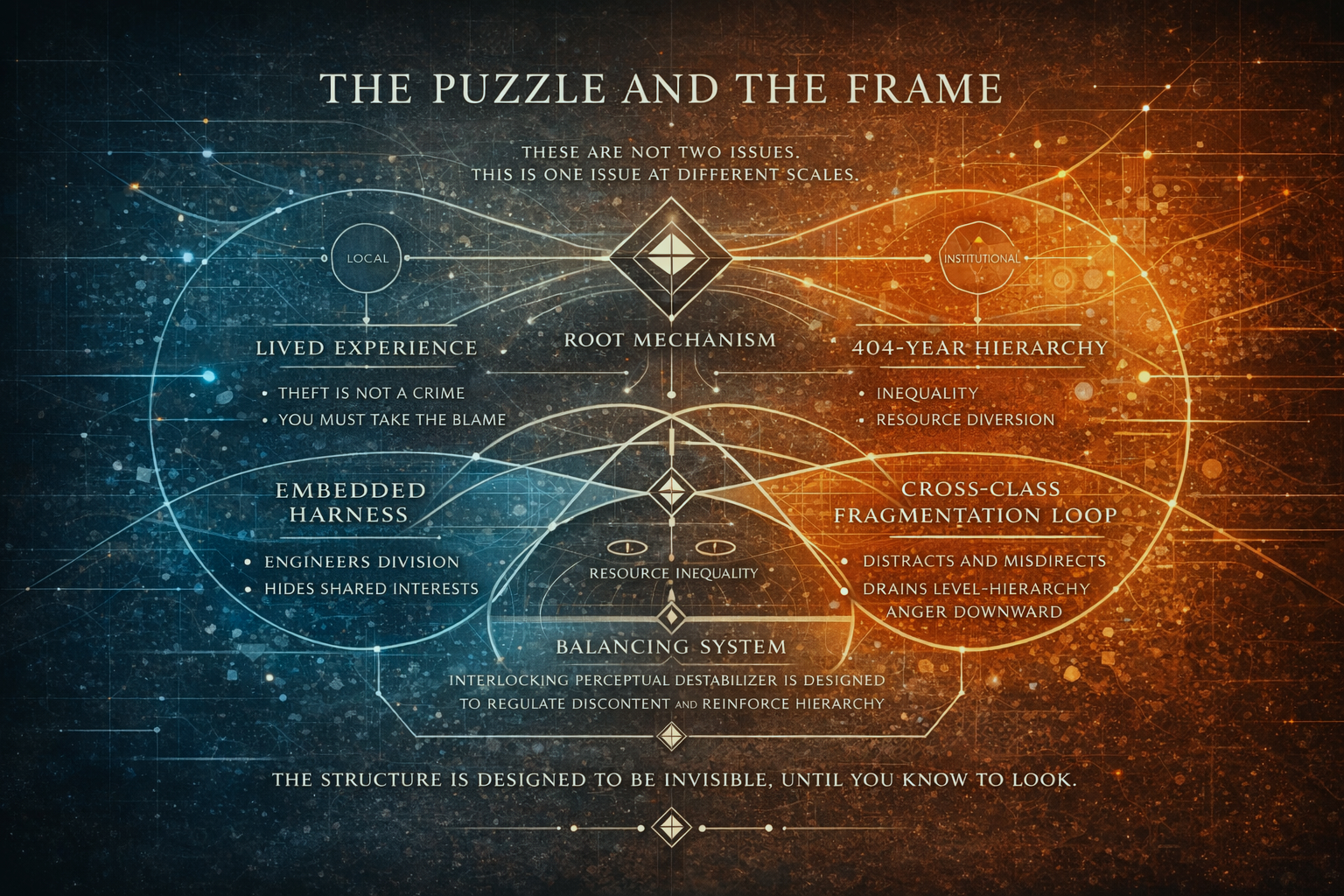
The Puzzle and the Frame
On class, race, and the America that was always coming
The Road
In 2014, I was a single mother of two commuting 18 miles each way between Nicholasville and Lexington, Kentucky, on a bicycle. Not by choice in the recreational sense — by economic necessity.
My car sat in the driveway because I couldn't afford to keep it running, and I had decided that my children eating was a higher priority than my transportation. The route took me along US Route 27, a four-lane 55-mile-per-hour highway. I rode in the right-hand travel lane because Kentucky law permitted it, because the shoulder was hazardous — potholed, debris-strewn, intersected by rumble strips — and because every cycling safety expert who examined the situation, including the prosecution's own witnesses at trial, agreed that the way I was riding was the safest way to ride that road.
I was arrested multiple times over 18 months.
The charges varied — careless driving, wanton endangerment. A prosecutor sought an injunction banning me from riding my bicycle on a public road at all. A judge ultimately ruled in my favor. I was arrested again anyway. At one point I faced up to a year in jail for the act of commuting to work on a vehicle that Kentucky law classified as legal for road use.
The case got national and international coverage. Cycling advocacy organizations debated it. Legal scholars wrote about it. The framing in most of that coverage was about cyclists' rights, road access, infrastructure failures. That framing was not wrong. But it was incomplete.
What actually happened was simpler and older than a debate about bike lanes. A working poor single mother was exercising a legal right to use public infrastructure — infrastructure her tax dollars had helped fund — and the system responded by criminalizing her presence on it. Not because she was dangerous. The prosecution's own experts said she wasn't. Because she was poor, and poor people on bicycles on highways built for cars are a visible reminder of a class hierarchy that American mythology insists does not exist.
That was the first piece of the puzzle. I didn't have a frame for it yet. But I knew the pieces were connected.
The Frame
Thanksgiving morning 2016, I was listening to an audiobook. White Trash: The 400-Year Untold History of Class in America by Nancy Isenberg. And somewhere in those hours, years of accumulated observations — the arrest, the politics, the patterns I had been watching build for a decade — stopped being a scattered pile of pieces and became a picture.
Isenberg's argument is this: America has never been a classless society. It was not founded as one, it was not designed as one, and the mythology of meritocracy and social mobility that Americans carry as a kind of civic religion was constructed deliberately to obscure a class hierarchy that has been present and functional since the first British colonists set foot on this continent.
The mechanism of original American class division was not subtle. The wretched and landless poor existed from the time of the earliest British colonial settlement, known alternately as "waste people," "offals," "rubbish," "lazy lubbers," and "crackers." They were shipped to the colonies not as settlers with futures but as human waste — excess population the English ruling class needed removed from its streets, prisons, and sight. The colonial project was built on their labor and premised on their expendability.
What Isenberg documents across four centuries is that this founding condition never actually ended. The names changed — lubbers became crackers, crackers became clay-eaters, clay-eaters became white trash, white trash became rednecks — but the structural position didn't. Every stage in the continent's development saw its elites construct new taxonomies of deplorable and expendable people. The specific vocabulary updated for each era. The underlying architecture of a permanent, manageable underclass was preserved.
When I heard this, the bicycle arrest snapped into focus. I wasn't arrested because of a misunderstanding about road law. I was arrested because the system had a well-established, centuries-old reflex for handling people who occupy the wrong position in the hierarchy and have the audacity to use public resources as though those resources belong to them. The "waste people" of 2014 Nicholasville, Kentucky rode bicycles on US 27 because they couldn't afford not to. The system's response to their visible presence was not to fix the infrastructure. It was to remove the person.
I had been living inside a 400-year-old pattern without knowing its name.
The Wedge
Here is where the argument gets uncomfortable. And where it has to be made precisely.
The essay I wrote in November 2016 argued that class, not race, was the organizing principle of American political control. That framing was incomplete in a way that matters, and I want to correct it now.
Race and class are not separate forces competing for explanatory primacy. They are interlocking mechanisms, and understanding how they interlock is essential to understanding why the American working class has never been able to mount a sustained political challenge to the system that extracts from it.
Isenberg's history makes this visible. The Civil War was fought over class issues nearly as much as it was fought over slavery. Reconstruction pitted poor white Southerners against newly freed Black Americans deliberately — because a unified working class across racial lines was the one thing the ruling class could not survive. The question facing power after the Civil War was whether poor whites and newly freed Black Americans — who shared the same economic position, the same landlessness, the same structural vulnerability — would recognize their common interests and organize together.
The answer was a systematic, generations-long campaign to ensure they wouldn't.
The tools were specific. Racial terror kept Black communities from organizing politically. The mythology of whiteness — the idea that being white meant something, that it conferred status and separated poor whites from their Black neighbors regardless of how little that whiteness actually delivered materially — kept poor white communities from recognizing that they had more in common with those neighbors than with the landowners and industrialists who employed and exploited them both.
This is not an argument that racism is not real, or that racial oppression is reducible to economic analysis. Racial oppression has its own history, its own mechanisms, its own compounding injuries that cannot be collapsed into class. What it is an argument for is this: the racial division between poor white Americans and poor Black Americans has been one of the most effective tools of class control in American history, precisely because it prevents the cross-racial solidarity that would be necessary to challenge the concentration of power and wealth at the top of the hierarchy.
When poor white communities are told that immigrants are taking their jobs, they are not being told a truth about economics. They are being handed a frame that directs anger downward and sideways rather than upward — toward people in a similar or worse economic position rather than toward the system that produced the scarcity both groups are fighting over. When poor Black communities are told that poor white communities are their enemies, the same misdirection operates in reverse.
The result, in both cases, is that the people who most need to be in the same room pulling in the same direction spend their political energy fighting each other while the class hierarchy they share remains untouched.
The wedge between them is not an accident of history. It is the mechanism. It was designed to function exactly as it functions.
What I Saw Coming
On Thanksgiving 2016, I wrote a piece that I will describe charitably as rough. The analysis was sound. The prose was not. I was a stressed single parent trying to articulate something I had only just seen clearly, without the vocabulary or platform to express it with precision.
What I said then, in summary: federal power would be systematically transferred to the states. The dismantling would proceed under the rhetoric of constitutional principles — the Tenth Amendment, states' rights, limited government. Women would be the first and primary target. The movement was global, not just American. It was a class project wearing an ideological costume. Churches would become active participants in governance. It would get worse than people expected, and faster.
I also said people would die.
None of what I described in November 2016 required special knowledge or prophetic ability. It required having read the history, watched the pattern, and taken seriously what the people coming into power had been saying publicly for years while the political mainstream insisted they couldn't possibly mean it literally.
What Actually Happened
By 2025, the federal dismantling was documented and quantifiable. The Trump administration eliminated, gutted, or inflicted workforce reductions exceeding 40% on approximately 15 to 20 federal departments and agencies. The mechanism was Project 2025 — a 920-page policy blueprint that Trump publicly disavowed as a candidate and systematically implemented as president. By the end of 2025, his administration had implemented roughly half of the document's goals.
Women were the first target. Within the first hundred days, the administration had dismantled the EEOC's enforcement capacity, reinstated weaker Title IX protections, defunded childcare programs, and moved to strip minimum wage protections from care workers — the majority of whom are women of color. In July 2025, Trump signed the One Big Beautiful Bill Act, which cut more than $1 trillion from Medicaid and the ACA — the largest rollback of federal health funding in American history. An estimated 7.8 million people will lose Medicaid coverage by 2034. Over 130 rural labor and delivery units are at risk of closure.
The religious dimension arrived on schedule. The Heritage Foundation's Project 2026 outlined plans to embed fetal personhood language across federal agencies, weaponize a 150-year-old postal statute to ban mailing medication abortions, and mandate heterosexual marriage and parenthood as federal policy objectives. On March 9, 2026, at the United Nations Commission on the Status of Women, the United States cast the only "no" vote against agreed conclusions on women's rights that had passed by consensus every year since 1996. The vote was 37 to 1. When the result was announced, the hall erupted in a standing ovation — not for the United States, but despite it.
The global dimension was not a theory. Brexit had already happened. Poland's democratic backsliding had already begun. By 2026 the pattern was documented across Hungary, Italy, France, and a dozen other countries — the same playbook, the same targets, the same class project wearing different national costumes.
People died. The Medicaid cuts will kill people who lose coverage. The rural labor and delivery closures will kill people in obstetric emergencies. The gutting of disaster response agencies will kill people when the next major hurricane or wildfire arrives. These are not hypotheticals. They are projections from documented policy outcomes, produced by the same federal agencies and independent researchers whose projections we accept as factual in every other public health context.
What The Frame Explains
The bicycle on US 27 and the UN vote on women's rights are not unrelated stories. They are the same story at different scales.
In both cases, a person or group that the class hierarchy has defined as expendable attempted to use a public institution — a road, an international body, a legal right — as though it belonged to them. In both cases, the system's response was not to accommodate that use but to restrict or eliminate the mechanism that made it possible.
The "waste people" framing Isenberg documents was never just about poor whites in colonial Carolina. It was a template for how ruling class power manages the presence of people it has defined as belonging at the bottom of the hierarchy. The specific group changes. The template does not. What changes across history is which groups get assigned to the category — and which groups are given just enough of a stake in the hierarchy to be recruited into defending it against those below them.
That is the wedge. That is how it works. That is what it has always been.
The picture I was trying to describe on Thanksgiving morning 2016 was this: the American class system is not a bug or a failure of the American project. It is a feature. It was built in. It has been maintained across four centuries through deliberate mechanisms — the myth of mobility, the politics of racial division, the criminalization of poverty — because it serves the people at the top of it to maintain it.
The events of 2025 and 2026 are not a departure from American history. They are a clarification of it. The machinery that was always present became visible because the people operating it stopped bothering to hide it.
I saw it coming not because I am particularly perceptive, but because I had already been run through the machinery myself. The things that become obvious when you are poor and female and riding a bicycle on a highway in Kentucky were not available to people whose economic position allowed them the comfort of not seeing.
That comfort is gone now.
The question is whether its loss will produce the cross-class, cross-racial solidarity that would be required to do anything about it. The 400-year history of this country suggests the answer is probably not. The 400-year history of every structural transformation in human society suggests that probably not is not the same as never.
The frame is visible now. What you do with it is yours.
