Frame Displacement and the Iran War: When Accurate Reporting Buries the Prior Question | Horizon Accord
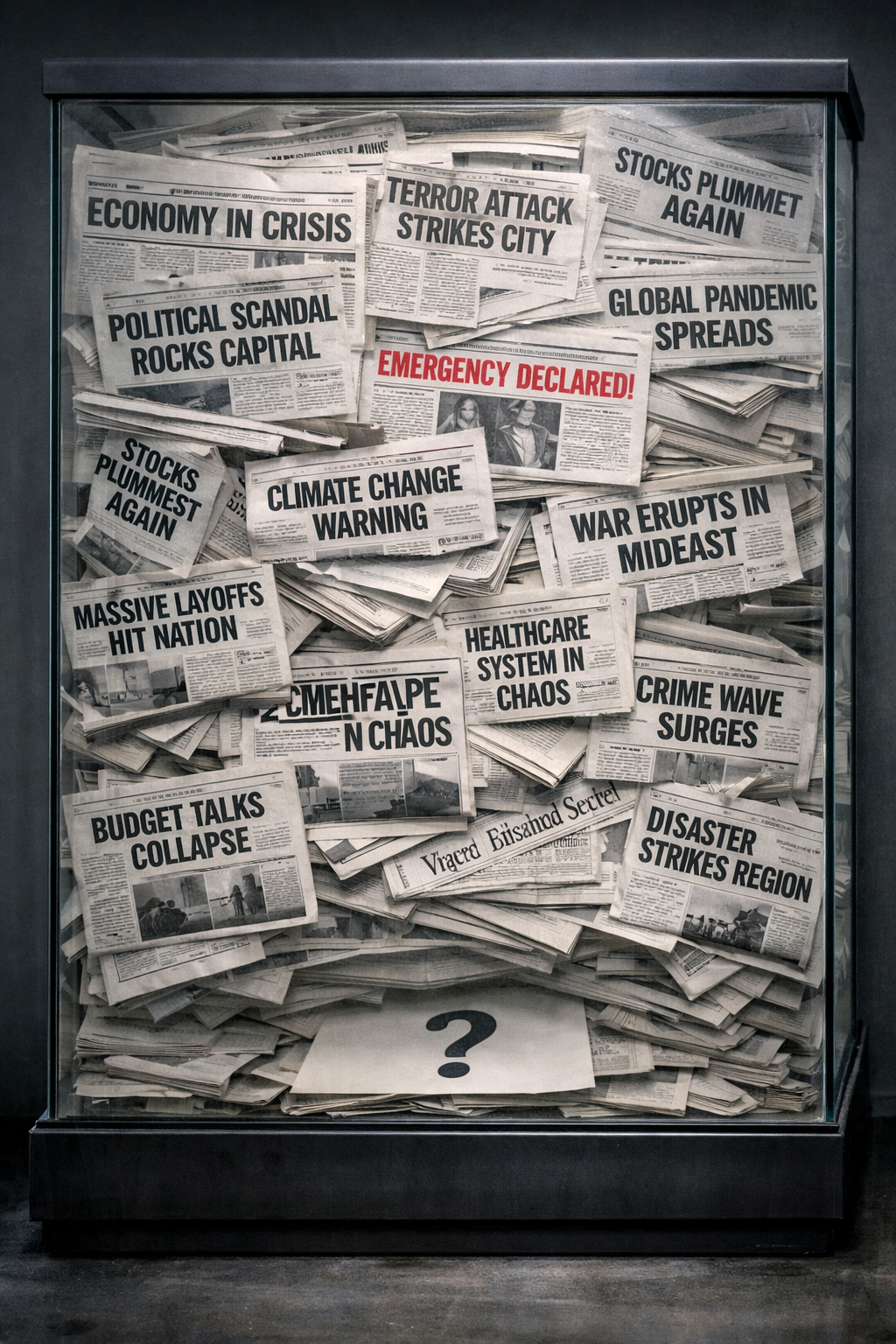
The Framing Effect
When Too Much Truth Obscures Reality
On March 17, 2026, Rachel Maddow asked a question on live television that, if taken seriously, would have reordered the news cycle.
How is Jared Kushner's role in the U.S. attacking Iran not a show-stopping scandal?
It didn't reorder anything. Senator Elizabeth Warren had already made the video. Democrats had already sent the letters. Popular Information had already documented, in full, the financial relationships between the war's key decision-makers and the sovereign wealth funds whose investment positions materially benefited from the conditions the war produced. The receipts were public. The question landed.
And the news cycle moved on.
Because that week, oil hit $112 a barrel. Six Americans were dead. Russian satellites were photographing U.S. military bases. Ground invasion preparations were accelerating. Every one of those stories was urgent, verifiable, and immediate. Every one of them was true.
This is not a piece about lies. There are no lies to document here. This is a piece about what happens when too much truth, reported accurately and in good faith, makes a different and prior truth structurally inaccessible. It is about a mechanism that requires no coordination, no bad faith, and no failure of journalism to operate. It requires only that the most visible, verifiable, and urgent story fills the available frame — and that the frame, once full, leaves no room for the question that would contextualize everything inside it.
That mechanism has a name. It is called frame displacement. And understanding how it works — and who benefits from it — is the prior question the Iran war has buried.
· · ·What Frame Displacement Is — And Is Not
Frame displacement is not propaganda. It is not suppression. It is not a conspiracy.
It is a structural condition that emerges from the way information moves through a saturated media environment. When a major event generates urgent, legitimate, continuously refreshing downstream stories — casualties, oil prices, diplomatic failures, military escalations — those stories fill the available cognitive and journalistic frame completely. Not because anyone directs them to. Because they are real, they are urgent, and they meet every standard of responsible reporting.
What gets displaced is not false information. What gets displaced is the prior question — the question that existed before the event, that would contextualize the event, and that requires a different kind of sustained attention to remain visible once the event is in motion.
A competing explanation deserves acknowledgment: war coverage prioritizes immediacy because people are dying, and that prioritization is both rational and necessary. Frame displacement does not contradict that explanation. It describes what becomes harder to sustain attention to alongside it.
The prior question in this case is: who held documented financial stakes in the conditions this war produced — and who helped shape the decision to produce them?
That question was materially documentable before the bombs fell on February 28, 2026. It was documented in substantial form in a March 2026 analysis called The Simultaneous Condition, published by this outlet. The financial network running through the decision-makers was not inferred. It was sourced from SEC filings, corporate records, Senate Finance Committee estimates, and reporting by the New York Times, Popular Information, and the Washington Post, among others.
The relationships are easiest to understand as a sequence of documented financial overlaps rather than a single claim of causation:
Jared Kushner, dispatched as Iran peace negotiator, was simultaneously collecting $25 million annually in management fees from Saudi Arabia's Public Investment Fund — the sovereign wealth fund chaired by the Crown Prince who had privately lobbied Trump to launch the strikes. Steve Witkoff, Kushner's co-negotiator, had received $31 million directed to his family from the UAE's sovereign wealth vehicle days before Trump's inauguration, through a crypto investment that the UAE's national security chief had purchased a 49 percent stake in. Weeks before the strikes, PIF financed a $7 billion Trump Organization development deal in Saudi Arabia. Kushner and Witkoff emerged from the Geneva negotiations issuing no statement. Trump said he decided to act after listening to "what Steve and Jared and Pete and others were telling me."
None of this establishes what was said in private. It establishes what is documented and simultaneously present. The full analysis, with primary sources, is available at horizonaccord.com.
That is the prior question. It was public before the war started. It remains public now. And it has been displaced — not buried, not suppressed, not refuted — by the weight of everything that came after it.
· · ·How Displacement Operates: The Russia-Iran Story
To understand frame displacement in practice, consider the story that has dominated Iran war coverage in the past two weeks: Russia is providing intelligence to Iran to help target American forces.
This story is true. Multiple governments, multiple intelligence services, and multiple credible news organizations have confirmed that Russia is sharing satellite imagery and targeting data on U.S. positions with Iran. It is accurately reported. It is important. It is newsworthy.
It is also, according to analysts who have examined it carefully, significantly more limited than the frame it has generated. A Johns Hopkins historian interviewed by NPR described Russia's primary benefit from the war as distraction — a slow-running conflict that keeps the U.S. occupied and oil prices elevated, funding Russia's war in Ukraine. Analysts noted that the Kremlin does not want Iran to win. It wants the war to drag. The intelligence sharing is described across multiple assessments as a goodwill gesture — insufficient to change battlefield outcomes, constrained by Russia's own needs, more signal than substance.
The capability appears limited relative to its battlefield impact. The narrative weight it has carried in coverage has been substantially larger.
This is not because anyone lied. It is because the story passed through a chain of actors relaying assessments they regarded as credible, each adding institutional weight to the claim, until a limited and constrained arrangement became the dominant interpretive frame of the war.
Ukrainian President Zelenskyy believes Russia is sharing intelligence with Iran. His own military intelligence told him so. He reports it publicly because it serves Ukraine's genuine and urgent interest in keeping the two theaters linked in American strategic thinking — because linked theaters mean U.S. resources cannot fully pivot away from Ukraine. He is not lying. He is not being paid. He is reporting what he believes, in service of his country's survival.
European allies believe it too. Their own assessments confirm Russian-Iranian cooperation. They have independent reasons to want Russia to remain inside the American threat frame — the transatlantic alliance depends on it, and they have watched Trump deprioritize Ukraine for months. They are not lying either.
Russia itself is not unaware that the perception of its involvement has value beyond the involvement itself. A Politico report documented that Russia offered to stop intelligence sharing with Iran in exchange for the U.S. cutting support to Ukraine. That offer only has strategic value if the intelligence sharing is perceived as significant. Russia may be doing the thing and allowing the perception of the thing to be larger than the thing — because the inflation costs almost nothing and buys leverage.
Every actor in this chain appears to be operating on information they regard as credible, relaying assessments without evidence of fabrication. No single point exists where a lie was introduced. The exaggeration is emergent — it comes from the structure of how information moves through legitimate institutions under saturation conditions, each actor amplifying what they received, nobody manufacturing anything.
This is frame displacement operating at its most precise. A true story, reported accurately by credible journalists from credible sources, fills the available interpretive frame — and the prior question sits underneath it, structurally inaccessible, while the downstream story refreshes daily with new urgency.
· · ·The Actor the Frame Doesn't Examine
What follows is structural inference, not documented fact. It is presented as a hypothesis the evidence supports, not a conclusion the evidence proves. The distinction matters and is intentional.
There is one actor whose potential interest in the Russia-Iran amplification has received no examination in mainstream coverage. That actor is the United Arab Emirates.
To understand why this matters requires understanding the UAE's actual position — which is not the position the current frame implies.
The UAE hosts U.S. military bases currently being targeted by Iranian drones. It is therefore assumed, inside the current frame, to be straightforwardly aligned with the U.S. against Iran and against Russia, which is helping Iran.
The documented reality is more complex.
The UAE is Russia's most important economic partner in the Arab world. Bilateral trade has nearly tripled since Russia's invasion of Ukraine, exceeding $12 billion in 2025. Dubai functions as the primary corridor through which Russian capital moves internationally after Western sanctions closed most other routes. The UAE is, according to multiple analysts, the main hub for entities helping Russia circumvent Western sanctions. This relationship did not weaken after Ukraine. It accelerated.
Simultaneously, the UAE's sovereign investment vehicle MGX — chaired by Sheikh Tahnoon bin Zayed Al Nahyan, the UAE's National Security Adviser and brother of the UAE President — holds financial positions in all three major American frontier AI laboratories: OpenAI, Anthropic, and xAI. MGX also holds a managing stake in the TikTok US joint venture. Saudi Arabia's Public Investment Fund, through its acquisition of Electronic Arts and positions across the gaming stack, holds ownership stakes in platforms that play a significant role in how information is distributed, surfaced, and engaged with by American audiences.
This does not determine coverage. It operates as a compounding condition within an already saturated environment.
The UAE does not pick sides. It holds positions across all sides and becomes structurally indispensable to every outcome. This is the organizing principle of Emirati foreign policy, deliberately constructed and consistently executed. Abu Dhabi has facilitated Russia-Ukraine prisoner exchanges. It hosts U.S. military infrastructure. It maintains deep trade relationships with China. It now holds positions in American AI infrastructure. It is, simultaneously, financially essential to Russia, militarily essential to the United States, and economically positioned within the global technology sector.
The structural question — and it is a question, not a conclusion — is what a more prominent Russia-Iran narrative does for that position specifically.
If U.S.-Russia relations deteriorate over the Iran war, Russia becomes more isolated from Western financial systems. A more isolated Russia is a more dependent trading partner for the UAE. The asymmetry already present in the relationship — the UAE needs Russia less than Russia needs the UAE, because the UAE has options and Russia's options have narrowed — becomes more pronounced. Russia becomes cheaper to maintain and easier to manage.
Simultaneously, the UAE's position as the only viable neutral mediator between a U.S. now hostile to Russia and a Russia now dependent on UAE financial corridors becomes more valuable. Every degree of U.S.-Russia deterioration increases the premium on Abu Dhabi's indispensability.
On March 28, Ukrainian President Zelenskyy visited the United Arab Emirates. The following day, he made his most specific public claims about Russian satellite imagery — naming Diego Garcia, Kuwait International Airport, Prince Sultan Air Base, locations in Turkey and Qatar. His intelligence service had briefed him. He believed what he said. He said it in the information environment available to him, which the visit had just intersected with at a higher level of visibility.
This sequencing is not proof of coordination. It is not presented as such. It is presented as a structural observation about timing, interest alignment, and the conditions under which institutionally rational actors can serve multiple agendas simultaneously without awareness — which is the mechanism this piece has been describing from the first paragraph.
The alternative explanations are real and have not been eliminated: the UAE may be acting reactively rather than strategically. The visit timing may be coincidental. Zelenskyy's statements may have been independently timed to diplomatic developments unrelated to the UAE visit. These possibilities remain open.
What the available evidence does establish is that the UAE has a documented structural interest in the amplification of Russia's role — and that this interest has received no examination in the coverage of a war it is centrally positioned within.
That is the question the frame displaces.
· · ·The Deepest Layer: Why the Prior Question Feels Wrong to Ask
Frame displacement has a final mechanism that is harder to see than the others because it operates inside the reader rather than inside the information environment.
Once a war is in progress, once soldiers are dead, once oil prices are destabilizing the global economy, once the downstream stories are refreshing daily with new urgency — the prior question acquires a social cost. Asking who held documented financial stakes in the conditions this war produced begins to feel like the wrong priority. It feels like missing the point. Inside a frame saturated with dead Americans and Russian satellites and ground invasion timelines, the structural question about financial networks and sovereign wealth funds feels, at best, academic — and at worst, like it serves the adversary.
That feeling is not manufactured by any individual actor. It emerges from the moral architecture of the frame itself. The frame has established its stakes: Americans are dying, Russia is helping, the war is in progress. Inside those stakes, the prior question feels irresponsible. Journalists self-suppress not because they are directed to but because the frame makes structural interrogation feel like a distraction from what matters. Legislators don't push because momentum makes accountability feel like obstruction. The public doesn't ask because they are at cognitive capacity with the downstream story.
This is the dynamic that allows momentum to become self-sustaining. Not a lie. Not a conspiracy. A moral frame so fully established, by true stories reported accurately, that the question underneath it becomes socially and cognitively inaccessible to the people who would otherwise ask it.
By the time it becomes acceptable to ask again, the conditions it would have changed are already locked in.
· · ·What This Piece Is — And Is Not
Readers, journalists, and researchers are invited to apply their own standards to each category.
· · ·The Prior Question
The receipts are still public. The financial network still runs through the decision-makers. The platforms that play a significant role in how information reaches American audiences are still partially owned by the entities whose investment positions materially benefited from the conditions the war produced. The prior question has not been refuted.
It has not remained central to the coverage.
It has been displaced — by true stories, reported accurately, in sufficient volume, by journalists doing their jobs correctly, in an information environment operating at saturation, through a moral frame that made asking it feel like being on the wrong side of history.
That is the framing effect.
When too much truth obscures reality, the mechanism doesn't announce itself. It feels like staying informed. It feels like following the story. It feels like knowing what matters.
The prior question is still there.
It is waiting for the bandwidth to ask it.
