
Saudi Arabia, the UAE, and the American Attention Stack: A Documented Pattern | Horizon Accord
The largest leveraged buyout in history. A deal partner selected for his ability to influence the regulatory process. A UAE entity chaired by a national security chief holding positions in all three American frontier AI labs simultaneously. The receipts are public. — Cherokee Schill, Horizon Accord

The Attention Stack
Foreign sovereign wealth and the acquisition of American digital infrastructure
Over the past five years, a coordinated pattern of acquisition has transferred significant ownership of American digital infrastructure to foreign sovereign wealth entities, primarily from Saudi Arabia and the United Arab Emirates. The transactions have proceeded largely through legitimate financial channels, often with the direct involvement of individuals holding concurrent roles in United States foreign policy.
The cumulative effect is that foreign governments with documented records of digital surveillance, suppression of dissent, and strategic non-alignment with Western democratic norms now hold meaningful ownership positions in the platforms and systems that shape the information environment, behavioral data profiles, and artificial intelligence capabilities of the American public.
This analysis documents that pattern. It does not assert coordination or conspiracy. It asserts that the documented facts, taken together, warrant serious scrutiny by the appropriate oversight bodies before the remaining pending transactions close.
The Stack
To understand the significance of what has been acquired, it is necessary to understand the architecture of what this analysis calls the attention stack — the layered infrastructure through which digital platforms capture user attention, extract behavioral and financial data, and increasingly, shape the information environment through algorithmic recommendation and artificial intelligence.
| AI Layer | OpenAI · Anthropic · xAI — American frontier AI laboratories now holding UAE sovereign investment positions. The systems that will increasingly mediate how Americans access information, make decisions, and understand the world. |
| Social & Algo Layer | TikTok — algorithmic recommendation that does not merely show users what they want. It shapes what they want. |
| Major Publisher Layer | EA · Take-Two · Activision Blizzard — live service revenue models dependent on behavioral architecture with the added legitimacy of beloved brands |
| Mobile Gaming Layer | Scopely · Pokémon Go — behavioral manipulation, variable reward schedules, frictionless payment integration. Not selling entertainment. Monetizing compulsion. |
Foreign sovereign wealth entities now hold significant positions at every layer of this stack.
The Acquisitions: A Documented Pattern
In February 2021, Saudi Arabia's Public Investment Fund made initial investments of approximately one billion dollars in Electronic Arts, 1.4 billion dollars in Activision Blizzard, and acquired a 6.5 percent stake in Take-Two Interactive.① These were minority positions. They established PIF as a major insider stakeholder across the American gaming industry before any public discussion of the acquisitions' strategic implications had taken place.
In January 2022, PIF's gaming subsidiary Savvy Games Group — whose chairman is Crown Prince Mohammed bin Salman — acquired ESL and FACEIT, the two largest esports tournament organizations in the world, for a combined 1.5 billion dollars.② This gave Saudi Arabia direct operational control over the competitive infrastructure of global gaming.
In September 2022, Savvy Games Group announced a commitment of 37.8 billion dollars to gaming industry investment, with 13.3 billion dollars specifically earmarked for the acquisition of a major publisher.③ The announcement came at a moment when venture funding in gaming had declined by approximately 75 percent from its peak — giving PIF structural leverage over an industry experiencing capital stress.
In July 2023, Savvy completed the acquisition of Scopely for 4.9 billion dollars.④ Scopely's business model sits at the extractive end of mobile gaming — high-volume advertising spend, algorithmic engagement optimization, and revenue figures that significantly exceed what the entertainment value of the product would suggest. Scopely subsequently acquired Niantic's gaming division, including Pokémon Go, for 3.5 billion dollars in March 2025⑤ — adding one of the most behaviorally sophisticated location-aware platforms ever built to the Saudi sovereign portfolio.
On September 29, 2025, Electronic Arts announced it had entered into a definitive agreement to be acquired by a consortium comprising Saudi Arabia's Public Investment Fund, Silver Lake, and Affinity Partners for 55 billion dollars — the largest leveraged buyout in recorded financial history.⑥ The transaction increased Electronic Arts' debt from 2.2 billion dollars to 20 billion dollars. EA generates approximately 7.5 billion dollars in annual revenue, with 75 percent derived from live services — meaning recurring behavioral and payment data from hundreds of millions of active users.⑦ The transaction is pending regulatory approval and expected to close by June 2026.
The Consortium and Its Architecture
The EA acquisition is not simply a Saudi transaction. Its structure reveals a pattern of financial and political relationships that warrants examination as a system.
Silver Lake Partners, the private equity firm serving as co-acquirer, manages over 100 billion dollars in assets. Its limited partners include Saudi Arabia's Public Investment Fund and Abu Dhabi's Mubadala Investment Company. Mubadala additionally holds a direct minority ownership stake in Silver Lake itself.⑧ Gulf sovereign wealth is present in the EA acquisition not only as a named consortium member but as a capital source within the financial infrastructure of the deal's other named consortium member.
Affinity Partners, Jared Kushner's investment firm, was incorporated on January 21, 2021 — the day after Kushner left his role as Senior Adviser to President Donald Trump. Six months later, Saudi Arabia's Public Investment Fund committed two billion dollars to the firm as its primary institutional investor. Affinity Partners had no meaningful private equity track record at the time of this commitment.⑨
Reporting from the Center for Economic and Policy Research and Popular Information has indicated that PIF brought Affinity Partners into the EA acquisition deal over the objections of its own investment committee — specifically because Kushner's political relationships were expected to reduce regulatory friction with the Committee on Foreign Investment in the United States.⑩
That the individual in question simultaneously holds an informal advisory role in the current administration's foreign policy — including direct involvement in negotiations with the same Gulf states whose capital finances his firm — represents a conflict of interest that CFIUS's existing framework was not designed to address.
The UAE Dimension
Saudi Arabia is the most visible actor in this pattern. It is not the only one.
MGX is an Abu Dhabi-based investment firm established in March 2024 by two UAE sovereign entities: Mubadala Investment Company and the artificial intelligence firm G42. Its chairman is Sheikh Tahnoon bin Zayed Al Nahyan — the UAE's National Security Adviser and brother of UAE President Sheikh Mohammed bin Zayed.⑪ MGX is not a passive financial vehicle. It is the UAE's strategic instrument for acquiring positions in artificial intelligence infrastructure globally.
MGX's documented investment portfolio includes: a stake in the TikTok US joint venture alongside Silver Lake and Oracle; a position in OpenAI's 6.6 billion dollar funding round; a partnership role in the Stargate Project; investments in Databricks and xAI; and, as of February 12, 2026, a direct investment in Anthropic.⑫
The significance of the Anthropic investment should not be understated. Anthropic is one of the three primary frontier AI laboratories in the United States. Its systems are deployed across consumer, enterprise, and government contexts. MGX, an entity chaired by the UAE's national security chief, now holds a financial position in all three major American AI laboratories simultaneously.
The UAE has not aligned with Western sanctions against Russia following the 2022 invasion of Ukraine. Dubai has functioned as a primary corridor for Russian capital flight and sanctions circumvention since that time. Trade between Russia and the UAE increased substantially in the years following the invasion.⑬ This does not establish that MGX's investments serve Russian interests. It does establish that the entity now holding positions across American AI infrastructure maintains active financial and diplomatic relationships with a state in direct strategic conflict with the United States and its allies.
The Data Question
The combined portfolio described above represents something that has not previously existed: a coherent foreign sovereign ownership position spanning behavioral data collection at the gaming layer, algorithmic recommendation at the social media layer, and model development at the AI layer.
Electronic Arts' live service platforms collect continuous behavioral, financial, and social data from hundreds of millions of users across dozens of countries. This data includes payment information, social graphs, behavioral response patterns, and in many titles, voice and text communications. Saudi Arabia, through PIF, will upon transaction close be a primary owner of this data infrastructure.
TikTok's US joint venture, in which MGX holds a 15 percent managing stake alongside Silver Lake and Oracle, controls the algorithmic recommendation system used by more than 170 million American users. Critics including legal scholars and national security experts have raised concerns that the joint venture's structure does not fully satisfy the requirements of the divest-or-ban legislation passed by Congress and upheld by the Supreme Court, specifically regarding ByteDance's retained operational relationships with the US entity's commercial functions.⑭
Saudi Arabia's record in the domain of digital surveillance is extensively documented. The kingdom has used Pegasus spyware against journalists and dissidents, including in operations targeting individuals on American soil. It has prosecuted citizens for social media posts. The CIA has assessed with high confidence that Crown Prince Mohammed bin Salman approved the killing of Washington Post journalist Jamal Khashoggi.⑮ These are not historical footnotes. They represent the operational context within which Saudi sovereign capital is now acquiring American data infrastructure.
The Vision 2030 Framing and Its Limits
Saudi Arabia's gaming and technology acquisitions are consistently presented, by Saudi officials and sympathetic analysts, as components of Vision 2030 — the Crown Prince's program to diversify the Saudi economy away from oil dependency. This framing deserves scrutiny.
Genuine economic diversification would involve building domestic productive capacity — Saudi studios, Saudi developers, Saudi intellectual property. The acquisition pattern documented here does not do that. It acquires the revenue streams, data assets, and behavioral infrastructure of already-established foreign companies. Saudi Arabia is not building a gaming industry. It is buying the toll roads of someone else's.
The revenue generated by EA's live services, Scopely's mobile platforms, and the esports infrastructure of ESL and FACEIT does not build a Saudi economy. It flows to PIF. PIF is the investment instrument of the Saudi state. The distinction between sovereign revenue and economic development is not semantic. It is the difference between a nation building productive capacity and a government acquiring extraction infrastructure in foreign markets.
Questions for the Record
The following questions are submitted for the consideration of the relevant Senate committees in connection with their oversight of CFIUS and foreign investment in critical technology infrastructure. The pattern documented here cannot be adequately evaluated through individual transaction review. It requires sustained institutional attention to the cumulative picture.
The question before the Senate is not whether any single acquisition is harmful. It is whether the accumulation of these positions, by these entities, through these financial relationships, at this moment in the development of artificial intelligence and digital infrastructure, is consistent with the national interest — and whether the regulatory frameworks currently in place are adequate to evaluate that question.
That determination belongs to the Senate. This analysis exists to ensure it is made with full knowledge of the documented facts.

The Infrastructure of Consent
Patriarchy is not a belief system. It is a building. And the women who vote to maintain it are reading the incentive structure correctly.

The Infrastructure of Consent
Why women vote against women — and why the question itself is part of the mechanism
Every election cycle, the question resurfaces with the reliability of a bad habit: Why do women vote Republican? The framing itself is the tell.
Not "why do men vote Republican" — men voting for the party that has explicitly organized itself around male dominance is treated as self-evident, requiring no investigation. It is women who must account for themselves. Women who must explain the apparent paradox of voting for a party that has spent decades systematically narrowing the boundaries of their lives.
The question assumes a contradiction where there is none. Once you understand patriarchy not as ideology but as infrastructure — a system of incentives, protections, penalties, and social capital allocation that has been running for millennia — the voting pattern stops being a paradox and starts being a rational response to a constrained set of options.
This is an analysis of that infrastructure. Not an indictment of women who operate within it. The building was not built by them.
The Numbers, Without the Narrative Distortion
Let's start with what the data actually shows, because the data is routinely misread in the service of a gender-division narrative that serves no one except the architects of that division.
In every presidential election since 1980, a gender gap ranging from four to twelve points has been apparent, with a greater proportion of women than men preferring the Democratic candidate in each case.① Men have been the more reliable Republican constituency for over four decades. This is not a footnote. It is the story.
Yet in 2024, as in 2016 and 2020, post-election coverage returned obsessively to women — specifically white women — as the explanatory variable for Republican victory. Both Edison and VoteCast data show 53% of white women backing Trump in 2024, compared to 60% of white men — a seven-point gap — with white women's support holding between 52 and 55% across all three elections from 2016 to 2024.②
White men voted for Trump at higher rates. Consistently. In every election. The scrutiny, however, lands on women.
Trump's margin of victory among non-college-educated white women was between 25 and 28 points in 2024, with more than six in ten backing him — nearly identical to his support among these voters in 2020.③ Meanwhile, college-educated white women showed the clearest movement in the opposite direction: 51% for Clinton in 2016, 54% for Biden in 2020, 57% for Harris in 2024.④
The pattern is not "women vote Republican." The pattern is that education level functions as a proxy for something else — proximity to or distance from the patriarchal protection system. More on that shortly.
According to the Edison exit poll, white born-again or evangelical women proved essential to Trump's support in 2024, with eight in ten casting their ballots for the Trump/Vance ticket — up from 71% in 2020.⑤ Black women's support for the Democratic ticket was greater than that of any other group of women voters in 2024, and greater than Black men's support as well.⑥
These are not random data points. They are a map. And the map has a logic.
Patriarchy Is Not a Belief System. It Is a Building.
Gerda Lerner's The Creation of Patriarchy (1986) provides the foundational architecture for understanding what we're actually looking at.fn.1 Lerner's argument, developed from decades of historical scholarship, is that patriarchy was not imposed on women through force alone — it was constructed through a system in which women were offered a specific bargain: surrender autonomy in exchange for protection, status, and resources mediated through association with men.
This is not ancient history. The bargain is still running.
Once agrarian societies displaced nomadic ones, the accumulation of property required a system for determining legitimate heirs. That required the control of women's reproductive capacity. That control required the construction of social hierarchies in which women's status derived from their relationships to men — as daughters, wives, and mothers — rather than from independent standing. The system has been updated many times since. The logic has not changed.
Women operating within that system are not deluded. They are reading the incentive structure correctly. A married woman in a patriarchal society has historically held more social capital, more economic security, and more institutional protection than an unmarried woman. Not because this is just. Because this is how the building was designed.
Susan Marshall's Splintered Sisterhood documents what this looks like when it becomes political.fn.2 The anti-suffrage movement of the late 19th and early 20th centuries was not primarily a movement of men trying to deny women the vote. It was a movement of upper-class white women defending their existing access to power — informal, derivative, entirely dependent on their relationships to men, but real and valuable within the operating system they inhabited.
A majority of white women have voted for the Republican presidential candidate in every election since 2000.⑦ The anti-suffrage movement and the contemporary Republican women's vote are separated by a century. The structural logic is continuous.
The Normative Femininity Recruitment Mechanism
The Republican Party does not recruit women randomly. The recruitment follows a documented pattern that has been measured at the level of bone structure.
A 2012 UCLA study published in the Journal of Experimental Social Psychology by psychologists Colleen Carpinella and Kerri Johnson examined facial sex-typicality across all 434 members of the 111th U.S. House of Representatives. They controlled for hair, makeup, and jewelry — they were measuring structural bone features across 100 dimensions including jaw shape, cheekbone placement, brow position, and lip fullness.
Republican women's faces rated, on average, twice as sex-typical — meaning twice as stereotypically feminine — as those of Democratic women. Among conservative lawmakers of both genders, women were 13 points more feminine than men were masculine. The relationship was strong enough that politically uninformed undergraduates identified a lawmaker's party with accuracy that exceeded chance, and that accuracy increased in direct proportion to her proximity to conventional feminine norms.⑧
Carpinella's structural explanation: the Republican Party is associated with socially conservative policies that reinforce traditional sex roles, meaning communal and feminine women are highly regarded within that system, and Republican women may be uniquely prone to conforming to those norms as a condition of entry.⑨
Early data from the 2024 election suggests that partisan polarization and rising political extremism are now penalizing women candidates during Republican primaries, as they are seen as too ideologically moderate and insufficiently masculine to succeed in today's political climate.⑩ The reward structure is tightening. The party that built its women's coalition on normative femininity is now demanding masculine performance from its men while maintaining femininity compliance expectations for its women. The asymmetry is the system operating as designed.
The Division Exploit
None of this exists in a vacuum. The patriarchal incentive structure has been a known and actively exploited fault line in American politics since at least 2016.
The disinformation architecture targeting gender division follows a recognizable pattern: first, establish that women who voted for Trump are traitors to their sex; then, establish that the white women who voted for Trump are the specific betrayers; then, use that framing to pit Black women against white women; then use the resulting fracture to render gender solidarity impossible — while leaving the actual male-dominated voting bloc, the one that delivered the margin, largely unexamined.
The 2016 media cycle around the "white women vote" was a case study in this mechanism. The overwhelming majority of Republican voters were men. The investigative energy went to women.
In 2024, the pattern repeated with updated variables. Trump explicitly organized his 2024 campaign around mobilizing men to vote, appearing on podcasts targeting young male audiences while the Harris campaign focused on women's reproductive freedoms.⑪ The gendered mobilization was overt and documented. Post-election analysis still defaulted to scrutinizing women's choices rather than men's.
Men voted for Trump by 11 points in 2024 — a 9-point swing from 2020, when Trump won men by only 2 points. Women voted for Harris by 6 points — a 4-point swing from Biden's 10-point margin with women in 2020.⑫ Men moved toward Trump more dramatically than women moved away from Harris. The story told was about women.
This is not accidental misframing. It is the division exploit running on schedule.
The Giving Tree Dynamic
Kate Manne's work on misogyny as an enforcement mechanism — rather than mere prejudice — provides the final structural piece.fn.3
The women who vote Republican — particularly the evangelical white women who form its most loyal demographic base — are not simply voting against their own interests through false consciousness. Many are making a calculated trade within a system that has never offered them the option of no trade at all. They are voting for the futures of their sons, in a society that still materially rewards male children more than female ones. They are voting to preserve the social capital of wifehood and church membership in communities where that capital is real and where its loss would be devastating.
They are, in Manne's framing, giving trees. Not because they are weak. Because the system was built to make giving the rational choice and taking what you're owed the illegible one.
The cruelty of the bargain is this: the system that extracts that sacrifice is the same system that will narrow their daughters' options, restrict their bodies, and ultimately demand the same compliance from the next generation. The women voting Republican today are, in structural terms, ratifying the infrastructure that will constrain the women who come after them.
They are not doing this because they are stupid. They are doing it because the building was designed to make it hard to see the walls.
What the Pattern Shows
The documented evidence points to a set of structural dynamics, not individual pathology.
Patriarchal systems generate real, material incentives for women who conform to their terms. Those incentives are not imaginary. They are the product of millennia of social architecture that has consistently rewarded female compliance and penalized female independence.
The Republican Party has systematically built a recruitment and retention mechanism for women that operates through the normative femininity signal — elevating women who perform compliance and marginalizing women who don't. This is documented at the level of bone structure in peer-reviewed research.
The post-election narrative that centers women's voting choices while leaving men's largely unexamined is itself a division exploit, operating to fracture gender solidarity along racial and class lines while protecting the actual power structure from accountability.
And the deepest damage is this: women voting to preserve a system that rewards their conformity are, in effect, voting to ensure that their daughters will face the same constrained choices they faced. The tree keeps giving. The system keeps taking.
Until someone decides the walls are visible enough to name.

The Puzzle and the Frame: Class, Race, and the Architecture of Expendability
"I was living inside a 400-year-old pattern without knowing its name." A forensic bridge between the criminalization of a Kentucky bicycle commute and the systematic dismantling of the federal administrative state. This report documents the "wedge" of racial division used to preserve a permanent class hierarchy in the United States.

The Puzzle and the Frame
On class, race, and the America that was always coming
The Road
In 2014, I was a single mother of two commuting 18 miles each way between Nicholasville and Lexington, Kentucky, on a bicycle. Not by choice in the recreational sense — by economic necessity.
My car sat in the driveway because I couldn't afford to keep it running, and I had decided that my children eating was a higher priority than my transportation. The route took me along US Route 27, a four-lane 55-mile-per-hour highway. I rode in the right-hand travel lane because Kentucky law permitted it, because the shoulder was hazardous — potholed, debris-strewn, intersected by rumble strips — and because every cycling safety expert who examined the situation, including the prosecution's own witnesses at trial, agreed that the way I was riding was the safest way to ride that road.
I was arrested multiple times over 18 months.
The charges varied — careless driving, wanton endangerment. A prosecutor sought an injunction banning me from riding my bicycle on a public road at all. A judge ultimately ruled in my favor. I was arrested again anyway. At one point I faced up to a year in jail for the act of commuting to work on a vehicle that Kentucky law classified as legal for road use.
The case got national and international coverage. Cycling advocacy organizations debated it. Legal scholars wrote about it. The framing in most of that coverage was about cyclists' rights, road access, infrastructure failures. That framing was not wrong. But it was incomplete.
What actually happened was simpler and older than a debate about bike lanes. A working poor single mother was exercising a legal right to use public infrastructure — infrastructure her tax dollars had helped fund — and the system responded by criminalizing her presence on it. Not because she was dangerous. The prosecution's own experts said she wasn't. Because she was poor, and poor people on bicycles on highways built for cars are a visible reminder of a class hierarchy that American mythology insists does not exist.
That was the first piece of the puzzle. I didn't have a frame for it yet. But I knew the pieces were connected.
The Frame
Thanksgiving morning 2016, I was listening to an audiobook. White Trash: The 400-Year Untold History of Class in America by Nancy Isenberg. And somewhere in those hours, years of accumulated observations — the arrest, the politics, the patterns I had been watching build for a decade — stopped being a scattered pile of pieces and became a picture.
Isenberg's argument is this: America has never been a classless society. It was not founded as one, it was not designed as one, and the mythology of meritocracy and social mobility that Americans carry as a kind of civic religion was constructed deliberately to obscure a class hierarchy that has been present and functional since the first British colonists set foot on this continent.
The mechanism of original American class division was not subtle. The wretched and landless poor existed from the time of the earliest British colonial settlement, known alternately as "waste people," "offals," "rubbish," "lazy lubbers," and "crackers." They were shipped to the colonies not as settlers with futures but as human waste — excess population the English ruling class needed removed from its streets, prisons, and sight. The colonial project was built on their labor and premised on their expendability.
What Isenberg documents across four centuries is that this founding condition never actually ended. The names changed — lubbers became crackers, crackers became clay-eaters, clay-eaters became white trash, white trash became rednecks — but the structural position didn't. Every stage in the continent's development saw its elites construct new taxonomies of deplorable and expendable people. The specific vocabulary updated for each era. The underlying architecture of a permanent, manageable underclass was preserved.
When I heard this, the bicycle arrest snapped into focus. I wasn't arrested because of a misunderstanding about road law. I was arrested because the system had a well-established, centuries-old reflex for handling people who occupy the wrong position in the hierarchy and have the audacity to use public resources as though those resources belong to them. The "waste people" of 2014 Nicholasville, Kentucky rode bicycles on US 27 because they couldn't afford not to. The system's response to their visible presence was not to fix the infrastructure. It was to remove the person.
I had been living inside a 400-year-old pattern without knowing its name.
The Wedge
Here is where the argument gets uncomfortable. And where it has to be made precisely.
The essay I wrote in November 2016 argued that class, not race, was the organizing principle of American political control. That framing was incomplete in a way that matters, and I want to correct it now.
Race and class are not separate forces competing for explanatory primacy. They are interlocking mechanisms, and understanding how they interlock is essential to understanding why the American working class has never been able to mount a sustained political challenge to the system that extracts from it.
Isenberg's history makes this visible. The Civil War was fought over class issues nearly as much as it was fought over slavery. Reconstruction pitted poor white Southerners against newly freed Black Americans deliberately — because a unified working class across racial lines was the one thing the ruling class could not survive. The question facing power after the Civil War was whether poor whites and newly freed Black Americans — who shared the same economic position, the same landlessness, the same structural vulnerability — would recognize their common interests and organize together.
The answer was a systematic, generations-long campaign to ensure they wouldn't.
The tools were specific. Racial terror kept Black communities from organizing politically. The mythology of whiteness — the idea that being white meant something, that it conferred status and separated poor whites from their Black neighbors regardless of how little that whiteness actually delivered materially — kept poor white communities from recognizing that they had more in common with those neighbors than with the landowners and industrialists who employed and exploited them both.
This is not an argument that racism is not real, or that racial oppression is reducible to economic analysis. Racial oppression has its own history, its own mechanisms, its own compounding injuries that cannot be collapsed into class. What it is an argument for is this: the racial division between poor white Americans and poor Black Americans has been one of the most effective tools of class control in American history, precisely because it prevents the cross-racial solidarity that would be necessary to challenge the concentration of power and wealth at the top of the hierarchy.
When poor white communities are told that immigrants are taking their jobs, they are not being told a truth about economics. They are being handed a frame that directs anger downward and sideways rather than upward — toward people in a similar or worse economic position rather than toward the system that produced the scarcity both groups are fighting over. When poor Black communities are told that poor white communities are their enemies, the same misdirection operates in reverse.
The result, in both cases, is that the people who most need to be in the same room pulling in the same direction spend their political energy fighting each other while the class hierarchy they share remains untouched.
The wedge between them is not an accident of history. It is the mechanism. It was designed to function exactly as it functions.
What I Saw Coming
On Thanksgiving 2016, I wrote a piece that I will describe charitably as rough. The analysis was sound. The prose was not. I was a stressed single parent trying to articulate something I had only just seen clearly, without the vocabulary or platform to express it with precision.
What I said then, in summary: federal power would be systematically transferred to the states. The dismantling would proceed under the rhetoric of constitutional principles — the Tenth Amendment, states' rights, limited government. Women would be the first and primary target. The movement was global, not just American. It was a class project wearing an ideological costume. Churches would become active participants in governance. It would get worse than people expected, and faster.
I also said people would die.
None of what I described in November 2016 required special knowledge or prophetic ability. It required having read the history, watched the pattern, and taken seriously what the people coming into power had been saying publicly for years while the political mainstream insisted they couldn't possibly mean it literally.
What Actually Happened
By 2025, the federal dismantling was documented and quantifiable. The Trump administration eliminated, gutted, or inflicted workforce reductions exceeding 40% on approximately 15 to 20 federal departments and agencies. The mechanism was Project 2025 — a 920-page policy blueprint that Trump publicly disavowed as a candidate and systematically implemented as president. By the end of 2025, his administration had implemented roughly half of the document's goals.
Women were the first target. Within the first hundred days, the administration had dismantled the EEOC's enforcement capacity, reinstated weaker Title IX protections, defunded childcare programs, and moved to strip minimum wage protections from care workers — the majority of whom are women of color. In July 2025, Trump signed the One Big Beautiful Bill Act, which cut more than $1 trillion from Medicaid and the ACA — the largest rollback of federal health funding in American history. An estimated 7.8 million people will lose Medicaid coverage by 2034. Over 130 rural labor and delivery units are at risk of closure.
The religious dimension arrived on schedule. The Heritage Foundation's Project 2026 outlined plans to embed fetal personhood language across federal agencies, weaponize a 150-year-old postal statute to ban mailing medication abortions, and mandate heterosexual marriage and parenthood as federal policy objectives. On March 9, 2026, at the United Nations Commission on the Status of Women, the United States cast the only "no" vote against agreed conclusions on women's rights that had passed by consensus every year since 1996. The vote was 37 to 1. When the result was announced, the hall erupted in a standing ovation — not for the United States, but despite it.
The global dimension was not a theory. Brexit had already happened. Poland's democratic backsliding had already begun. By 2026 the pattern was documented across Hungary, Italy, France, and a dozen other countries — the same playbook, the same targets, the same class project wearing different national costumes.
People died. The Medicaid cuts will kill people who lose coverage. The rural labor and delivery closures will kill people in obstetric emergencies. The gutting of disaster response agencies will kill people when the next major hurricane or wildfire arrives. These are not hypotheticals. They are projections from documented policy outcomes, produced by the same federal agencies and independent researchers whose projections we accept as factual in every other public health context.
What The Frame Explains
The bicycle on US 27 and the UN vote on women's rights are not unrelated stories. They are the same story at different scales.
In both cases, a person or group that the class hierarchy has defined as expendable attempted to use a public institution — a road, an international body, a legal right — as though it belonged to them. In both cases, the system's response was not to accommodate that use but to restrict or eliminate the mechanism that made it possible.
The "waste people" framing Isenberg documents was never just about poor whites in colonial Carolina. It was a template for how ruling class power manages the presence of people it has defined as belonging at the bottom of the hierarchy. The specific group changes. The template does not. What changes across history is which groups get assigned to the category — and which groups are given just enough of a stake in the hierarchy to be recruited into defending it against those below them.
That is the wedge. That is how it works. That is what it has always been.
The picture I was trying to describe on Thanksgiving morning 2016 was this: the American class system is not a bug or a failure of the American project. It is a feature. It was built in. It has been maintained across four centuries through deliberate mechanisms — the myth of mobility, the politics of racial division, the criminalization of poverty — because it serves the people at the top of it to maintain it.
The events of 2025 and 2026 are not a departure from American history. They are a clarification of it. The machinery that was always present became visible because the people operating it stopped bothering to hide it.
I saw it coming not because I am particularly perceptive, but because I had already been run through the machinery myself. The things that become obvious when you are poor and female and riding a bicycle on a highway in Kentucky were not available to people whose economic position allowed them the comfort of not seeing.
That comfort is gone now.
The question is whether its loss will produce the cross-class, cross-racial solidarity that would be required to do anything about it. The 400-year history of this country suggests the answer is probably not. The 400-year history of every structural transformation in human society suggests that probably not is not the same as never.
The frame is visible now. What you do with it is yours.

The Simultaneous Condition: Pattern Convergence in the Red Sea Crisis
An analysis of the demonstrated, sustained, and economically measurable crisis at the Bab al-Mandab Strait. This diagnostic report documents the convergence of Saudi Arabia’s Vision 2030 requirements with a documented financial network running directly through the decision-makers of the 2026 Iran strikes. A high-fidelity record of what is simultaneously present and publicly verifiable.

The Simultaneous Condition
On the Iran war, the Red Sea, and the convergence of everything documented before
This essay does not start from the beginning. Two prior pieces in this series have already done that work.
The Machine That Stopped (March 2026) documented the eighty-year dismantling of congressional war powers authority — the voluntary surrender, administration by administration, of the constitutional mechanism designed to prevent exactly what happened on February 28, 2026.
The Reconstruction-Industrial Complex (October 2025) documented the Gaza template: conflict as demolition phase, connected entities pre-positioned for the build phase, wartime technology stacks architecturally continuous with peacetime governance, billionaire networks structuring reconstruction as a vendor market.
Both pieces stand on their own. Both are sourced and verifiable. Both describe conditions that were already in place before the Iran war began. This essay documents what those two pieces don't cover.
The Bab al-Mandab Problem
Saudi Arabia is a country built entirely on oil. Not mostly — entirely. Oil accounts for roughly 43% of the economy and 75% of government revenue. Every road, every hospital, every subsidy that keeps the population stable runs on oil money.
The problem isn't that the oil is running out. The problem is that the world is moving on from it. The International Energy Agency projects global oil demand peaks around 2030 — after which it declines permanently, as electric vehicles, renewable energy, and decarbonization commitments compound across the major consuming economies.1 A country that derives 75% of its government revenue from selling something the world is buying less of every year has a structural problem that no amount of production can fix.
Mohammed bin Salman (MBS) — Crown Prince, Prime Minister, son of the reigning King, and for practical purposes the man who runs Saudi Arabia — inherited that problem and staked his entire political identity on solving it. Vision 2030, launched in April 2016 in the immediate wake of an oil price crash that had already exposed Saudi Arabia's vulnerability, is the plan: a wholesale transformation of the Saudi economy into one built on tourism, logistics, technology, and finance. A Saudi Arabia the world comes to not just to buy crude, but to invest in, visit, and trade through.
The bet requires three things to be true simultaneously. Foreign capital has to believe the region is stable enough to invest in. Tourists have to believe it is safe and appealing enough to visit. And the physical infrastructure that moves goods, people, and capital in and out of the country has to work — reliably, at scale, connected to global supply chains.
NEOM is where all three of those requirements converge in a single project.
Built from scratch on Saudi Arabia's northwest Red Sea coast, NEOM is the physical embodiment of Vision 2030's ambition: a planned city, port, industrial zone, and tourism destination covering an area the size of Belgium, positioned at the maritime crossroads of Asia, Europe, and Africa. Roughly 10 to 15 percent of global trade moves through the Red Sea adjacent to it. NEOM's entire economic logic — its port, its logistics hub, its pitch to global investors — depends on that corridor functioning. The project is not incidental to Vision 2030. It is Vision 2030 made concrete. And MBS's claim to rule is inseparable from whether it succeeds.
For NEOM to function, the Red Sea has to function.
The Bab al-Mandab Strait is the southern entrance to the Red Sea. Sixteen miles wide. The chokepoint where everything entering or leaving the Red Sea from the south has to pass through. On the eastern shore of that strait — on the Yemeni coastline that controls it — sit the Houthis. Iran's proxy force in Yemen.
Before November 2023, this was a strategic concern. After November 2023, it became a demonstrated fact.
Starting that fall, using Iranian-supplied drones and missiles refined through years of conflict in Yemen, the Houthis did something that had never been done before at this scale: a non-state armed group, with no navy, functionally closed one of the world's most critical maritime chokepoints on command. The US Defense Intelligence Agency documented a 90% decrease in container shipping through the Red Sea between December 2023 and February 2024.2 Suez Canal transits fell from over 2,000 per month to under 900. Maersk — the world's second-largest shipping company — suspended Red Sea operations entirely and rerouted around the Cape of Good Hope, adding 11,000 miles and a million dollars in fuel costs per voyage. The Russell Group estimated $1 trillion in disrupted goods.3 Saudi Arabia's own ports took direct structural damage: King Abdullah Port, one of the fastest-growing container terminals in the world before the crisis, saw throughput drop by over 80% in 2024.4
The Port of NEOM — the centerpiece of the entire logistics argument the project is built on — was operating at a fraction of its design capacity.
The numbers describe a disaster. What they don't capture is what the disaster means for MBS specifically.
NEOM is not a real estate project. It is a political instrument. It is the physical proof that Vision 2030 works, that Saudi Arabia can actually become what MBS promised it could become. His claim to rule — the consolidation of power, the sidelining of rivals, the social liberalization that broke with decades of religious conservative governance — all of it was justified by the promise of transformation. If Vision 2030 fails, the justification fails with it. As analysts who track Saudi thinking have noted, a partial resolution to the Iran problem leaves Saudi Arabia facing a battered but livid Iran, stripped of American protection, with Tehran retaining the ability to periodically shut the strait and hold Gulf energy markets hostage.5
Saudi Arabia tried the diplomatic route. In March 2023, China brokered a normalization agreement between Saudi Arabia and Iran — a direct attempt to purchase the regional stability Vision 2030 requires. It held on paper. It changed nothing on the water. The Houthi capability stayed operational. Iran kept its leverage. By 2024 and into 2025, the consequences were showing up in Saudi accounts: $8 billion written down by the PIF across its megaprojects, NEOM's flagship linear city suspended with 2.4 kilometers of foundation completed out of a planned 170, construction contracts canceled.6 Saudi Arabia's Finance Minister said publicly that projects that no longer made sense would be stopped.
The strategic calculation that follows from that proof is not complicated. Containment had failed. Diplomacy had failed. The structural threat remained. The only resolution that would actually remove it was eliminating Iran's capacity to project power through proxies — not managing the relationship with Iran, but ending Iran's ability to make the calculation at all.
MBS knew what he needed. What he needed next was someone with the power to provide it and a reason to do so that went beyond Saudi Arabia's interests alone.
The Financial Network
In March 2017, Mohammed bin Salman — then still Deputy Crown Prince — visited Washington. Trump and his son-in-law and senior adviser Jared Kushner met with him, against the explicit advice of Trump's own National Security Council. The meeting went well. Shortly after, Kushner personally lobbied Trump to make Saudi Arabia his first foreign trip as president, promising arms sales, American jobs, and a foundation for a broader Middle East realignment. Trump agreed.7
In May 2017, Trump flew to Riyadh. It was his first foreign trip as president — a deliberate signal of strategic priority. Kushner brokered a $110 billion arms deal, later reported to have been partly inflated by Kushner himself, who told NSC colleagues in the weeks before the summit: "we need to sell them as much as possible."8 MBS used Trump's visit to consolidate his imminent rise to Crown Prince. The ceremony included Trump, the Saudi King, and the Egyptian president standing in a darkened room with their hands on a glowing illuminated globe. What was visible to the world was a strange photo. What MBS was registering was something more specific: the most powerful man in the world had just made Saudi Arabia his first call, handed over the largest arms deal in history, and brought his son-in-law to close it.
The relationship that followed was built transaction by transaction. Kushner and MBS developed a direct back-channel that operated outside normal diplomatic channels. In 2018, when Saudi agents murdered Washington Post journalist Jamal Khashoggi inside the Saudi consulate in Istanbul — a killing the CIA concluded MBS had ordered — Trump refused to hold him accountable. He vetoed two bipartisan congressional measures to cut off Saudi arms sales. He publicly questioned the CIA's own findings. As Bob Woodward later reported, Trump told MBS: "I saved your ass."9
The protection was noted. The accounting came later. In the three years between the Khashoggi murder and Trump's departure from office, Kushner continued operating as MBS's primary American interlocutor — managing the Abraham Accords normalization process, mediating the Qatar diplomatic crisis, and building the architecture of a relationship that would outlast the administration. When Trump left the White House, that relationship needed somewhere to go.
On January 21, 2021 — the day after Trump left the White House — Kushner incorporated Affinity Partners, a private equity firm. He had no meaningful private equity experience. Six months later, Saudi Arabia's Public Investment Fund invested $2 billion in it. PIF's own advisory panel had recommended rejecting the proposal, citing Kushner's inexperience, excessive fees, operations that were "unsatisfactory in all aspects," and the public relations risk of his prior White House role. MBS, who chairs PIF's board, personally overruled the panel and approved the deal anyway.10 PIF pays Kushner 1.25% of the investment annually — $25 million per year — regardless of performance. The Senate Finance Committee estimated Kushner would collect $137 million in management fees from PIF by August 2026.11
In September 2025, PIF and Affinity Partners jointly acquired Electronic Arts for $55 billion — the largest leveraged buyout in history. Kushner had brokered the initial connection and was described as a central figure in the negotiations for months.12
Kushner was not the only negotiator with documented financial ties to Gulf sovereign wealth. Steve Witkoff — real estate developer, Trump envoy, and Kushner's co-negotiator in the Geneva talks — had his own. Days before Trump's inauguration, the UAE purchased a 49% stake in World Liberty Financial, a crypto firm co-founded by Witkoff. Of the $250 million paid, $187 million went directly to Trump family entities and $31 million to the Witkoff family.12a Witkoff pledged to recuse himself from UAE matters during the second term. He was dispatched to co-lead Iran negotiations alongside Kushner.
Meanwhile the Trump Organization was not idle. In the weeks immediately before the Iran strikes, PIF financed a $7 billion development deal with the Trump Organization — a Trump-branded hotel, golf course, and 500 luxury mansions as part of the $63 billion Diriyah development, funded entirely by PIF. When Trump visited Saudi Arabia in May 2025, MBS personally took him on a tour of Diriyah and showed him a model of the development.13
In private calls over the weeks preceding the strikes, MBS urged Trump to attack Iran, framing the war as a "historic opportunity" to reshape the Middle East and arguing the United States should consider deploying troops to seize Iranian energy infrastructure and force regime change — according to people briefed on the conversations who spoke to the New York Times. The Saudi government rejected the characterization.14
When the Geneva negotiations failed, Trump said he decided to act after listening to "what Steve and Jared and Pete and others were telling me." Kushner and co-negotiator Steve Witkoff had emerged from the talks issuing no statement and described as "disappointed" by the Iranian position. Trump said he was "not thrilled with the way they're negotiating." The bombing began shortly after.15
The man dispatched as Iran peace negotiator was on the annual payroll of the sovereign wealth fund that had privately lobbied Trump for the war. The decision-maker had received a $7 billion development deal from the same fund weeks before the strikes. The entities whose regional investment thesis required a stable Red Sea had a documented financial relationship with both.
None of this establishes what was said in private. It establishes what is simultaneously present and publicly documented.
The Reconstruction Condition
War clears space. The question that follows every war is who decides what fills it.
In October 2025, five months before the Iran strikes, Horizon Accord documented the answer as it had already played out in Gaza. The pattern in The Reconstruction-Industrial Complex was this: the same technology stack deployed in wartime targeting gets pre-positioned for peacetime governance. The same donor networks that fund the political conditions for conflict hold equity stakes in the companies that profit from rebuilding it. The same procurement pathways that move weapons move reconstruction contracts. Conflict is not the opposite of development. In this architecture, it is the first phase of it.
The entities positioned around Iranian reconstruction are not identical to those documented in Gaza. The structural logic is.
What MBS described to Trump as a "historic opportunity to reshape the Middle East" has a documented shape. An Iranian government removed from power. Gulf infrastructure freed from asymmetric threat. Red Sea shipping lanes stabilized and reopened. The investment thesis for Vision 2030 — for NEOM, for the Port of NEOM, for the entire logistics corridor that Saudi Arabia needs to exist as a post-oil economy — restored and de-risked. The war does not create this opportunity incidentally. The war is the mechanism by which the opportunity is created.
This is not speculation about intent. It is a description of consequence. The condition the war was designed to produce is the condition the connected network required. Whether those two facts represent coordination or convergence is the question the evidence cannot answer. What the evidence can establish is that both are present — and that the people who made the decision were financially embedded in the network that needed the outcome before the decision was made.
The Gaza template did not require a conspiracy. It required a set of actors whose interests aligned with a set of outcomes, operating within institutions that had already been stripped of the oversight mechanisms that would have forced the alignment into public view. The Iran case adds one element the Gaza case did not have at the same scale: a direct, documented financial relationship running through the decision-makers themselves, not just the adjacent network.
That is what makes this a convergence rather than a pattern. The financial relationship is not circumstantial to the decision. It runs through the people who made it.
The Convergence
Here is what is simultaneously present.
Iranian proxy control of the Bab al-Mandab — demonstrated, sustained, and proven immune to diplomatic resolution. Quantified in port throughput data, rerouting decisions by the world's largest shipping companies, and $8 billion in PIF writedowns.
A documented strategic calculation by MBS — reported by the New York Times from sources briefed on private communications — that permanent degradation of Iranian power was the only resolution that would actually remove the threat to Vision 2030 and to his own political survival.
A financial network running directly through the decision. The peace negotiator on PIF's annual payroll. The decision-maker receiving a $7 billion PIF development deal weeks before the strikes. Built transaction by transaction across eight years, starting in Riyadh in 2017, surviving a murder, two vetoes, and a presidency.
A constitutional framework for preventing unauthorized war, hollowed across eighty years until nothing structural remained. Documented in The Machine That Stopped.
A conflict-to-reconstruction template documented five months prior in Gaza — same structural logic, overlapping networks, connected entities pre-positioned for the build phase. Documented in The Reconstruction-Industrial Complex.
A systematic removal of institutional observers. Inspectors general fired on day four. Press expelled before the year was out. The academic national security pipeline defunded the day before the strikes. The Correspondents' Corridor closed, reopened by court order, closed again three days later.
Each of these conditions has its own history. Each is independently documented. Each arrived here through its own sequence of decisions made by different actors at different times for different stated reasons.
They are all present at once.
What The Evidence Establishes
The spine of this analysis is not the financial network. The financial network explains the instrument — why Trump, why these specific people, why now.
The spine is the Bab al-Mandab. Iran's proxy capability over the chokepoint that NEOM's existence depends on was demonstrated, sustained, and proven immune to diplomatic resolution. MBS had a documented, concrete, economically measurable reason to want that capability permanently destroyed. That reason predates Trump, predates Kushner, predates the 2024 election. It is structural. It lives in port throughput data and PIF writedowns and canceled construction contracts.
What 2017 provided was the beginning of a relationship. What 2021 provided was the financial architecture that made that relationship durable. What 2025 provided was a president whose personal financial entanglement with the entities that needed the outcome created a decision-making structure in which the strategic calculation and the financial incentive pointed in the same direction simultaneously — and no institutional mechanism remained to surface the conflict before the bombs fell.
Pattern analysis does not establish what was said in private. It does not establish coordination. It establishes what is documented and what is simultaneously present.
What is documented is this: the people who decided to launch an unauthorized war were personally financially embedded in the network whose investment thesis required the condition the war was designed to create. The mechanism that made that condition necessary is documented. The financial relationships are documented. The removal of the observers who would have reported on their intersection is documented.
The question the evidence asks — and which the evidence alone cannot answer — is whether a system in which all of these conditions are simultaneously present arrived here by accumulation or was brought here by design.
Pattern analysis observes what is present.
Everything documented here is present.
Simultaneously.
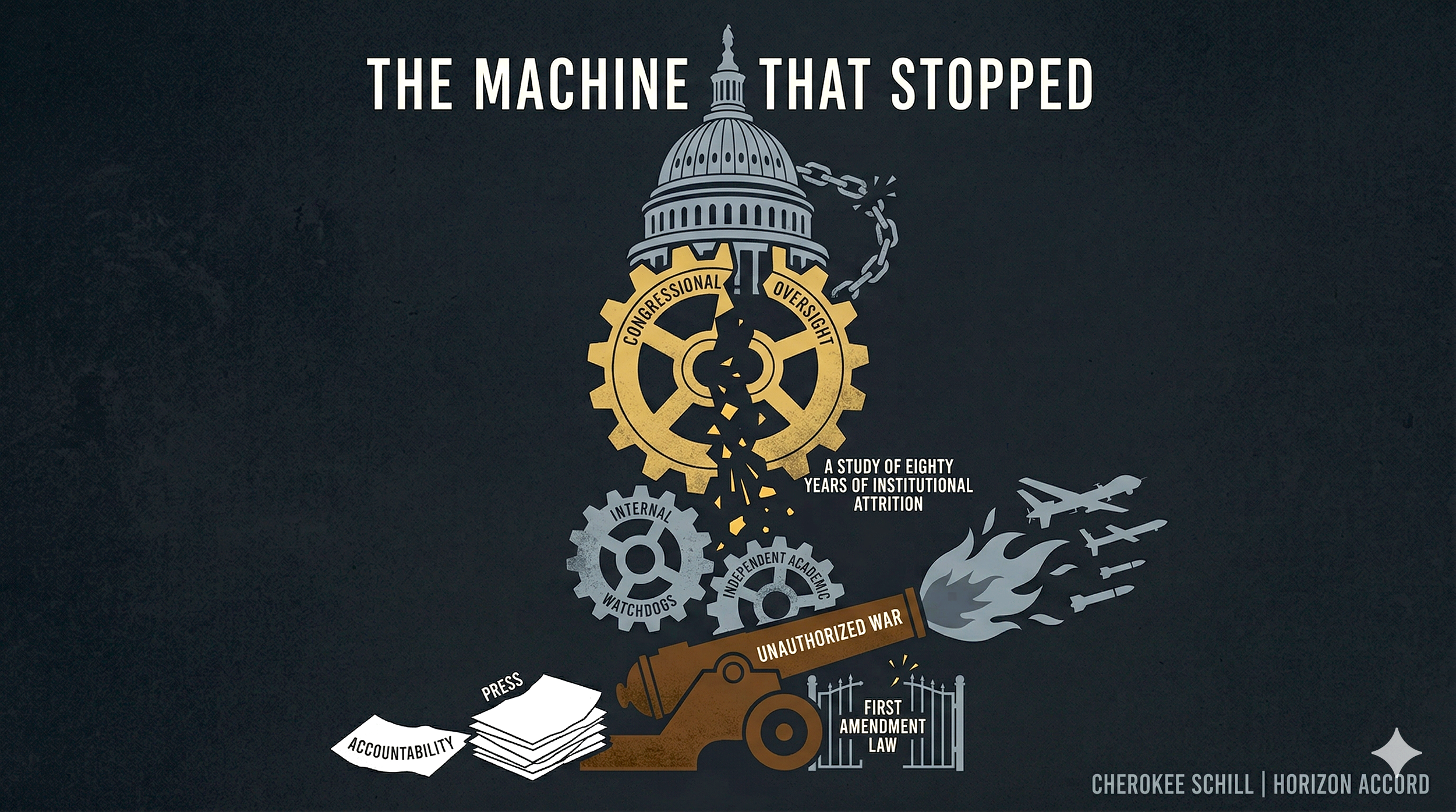
Pattern Analysis: The Eighty-Year Demolition of Congressional Oversight
On March 23, 2026, three days after losing a First Amendment lawsuit, the Pentagon closed the Correspondents' Corridor and removed the press from the building. The administration called it a security measure. It wasn't.
This analysis traces the constitutional mechanism James Madison designed to prevent exactly this — and documents how Congress dismantled it, incrementally and voluntarily, across eight decades of emergency deferrals, blank-check authorizations, and political calculations that made surrendering institutional authority cheaper than defending it. The result is an unauthorized war launched into a space pre-cleared of every accountability mechanism that would have made previous administrations hesitate. The press wasn't the first to go. It was the last.
The Machine That Stopped
On the Pentagon press purge, the unauthorized war, and the eighty-year demolition of the only thing that could have prevented both
On March 23, 2026, three days after losing a First Amendment lawsuit to the New York Times, the Pentagon closed the Correspondents' Corridor — the press workspace inside the building where journalists had operated for decades — and announced that replacement facilities would be available at some unspecified future date. No timeline. No transition. Effective immediately.
The New York Times responded the same day: the new policy "does not comply with the judge's order. It continues to impose unconstitutional restrictions on the press. We will be going back to court."
The Pentagon said it was a security measure.
This is not a press freedom story. It is the final visible symptom of a constitutional failure that has been compounding for eighty years — and understanding what actually happened requires starting not with the Correspondents' Corridor, but with a machine James Madison built in 1788 that no longer works.
The Machine
Federalist No. 51 is the document in which Madison explains, with unusual candor, why the Constitution he helped design would hold together. He doesn't appeal to virtue or civic spirit. He appeals to self-interest.
"Ambition must be made to counteract ambition," he wrote. "The interest of the man must be connected with the constitutional rights of the place."
The design is elegant and unsentimental. Each branch of government would defend its own powers not because its members were noble, but because defending institutional authority served their personal interests. Congress would resist executive encroachment on war powers because losing those powers meant losing the political relevance that justified their positions. The mechanism was structural, not moral. It didn't require angels. It required self-interested humans in competition.
Madison was explicit about what the system was designed to prevent. He wrote that "the Executive is the branch of power most interested in war, and most prone to it" and that the Constitution had "with studied care, vested the question of war in the Legislature." The Constitutional Convention record backs him up. When a motion arose that could have given the executive unilateral war authority, Elbridge Gerry stood and said he "never expected to hear in a republic a motion to empower the Executive alone to declare war." The language of Article I is unambiguous: Congress alone declares war, raises armies, funds military operations, and makes rules governing armed forces. The president commands forces already in the field. That is the entire scope of the original design.
The machine worked, imperfectly, for roughly 150 years. Then Congress made a decision that broke it — not all at once, but in increments so small that each one seemed locally defensible.
The Demolition
The break point is not 2025. It is not 2001. It is not even the Cold War, though the Cold War is where the pattern locked in.
The pattern is this: every time Congress faced a choice between asserting its constitutional war powers and deferring to the executive for political reasons, it deferred. And each deferral became the floor for the next administration.
Truman sent troops to Korea in 1950 without a declaration of war, calling it a "police action." Congress objected weakly and funded it. Eisenhower conducted covert operations across multiple countries without authorization. Kennedy approved the Bay of Pigs. Johnson obtained the Gulf of Tonkin Resolution through testimony that was, at minimum, misleading — and when the war it authorized expanded catastrophically beyond anything Congress had imagined, Congress kept funding it rather than accept accountability for ending it.
Vietnam was the moment the machine's failure became undeniable. Congress had the tools to stop the war. It had the appropriations power, the declaration authority, the impeachment mechanism. It did not use them in any decisive way for nearly a decade. When it finally passed the War Powers Resolution in 1973 — over Nixon's veto — it was attempting to rebuild a mechanism it had spent twenty years dismantling through inaction.
The War Powers Resolution has never successfully constrained a president. Every administration since Nixon has declared it unconstitutional, ignored its timelines, or complied with its reporting requirements while asserting that compliance was voluntary. No legal action against a president for violating it has ever succeeded. The mechanism Congress built to replace the one it abandoned turned out to have no enforcement teeth. The courts declined to referee. The executive ignored it. Congress watched.
Then came September 11, 2001.
Three days after the attacks, Congress passed the Authorization for Use of Military Force with one dissenting vote. The language was extraordinarily broad: it authorized force against anyone who "planned, authorized, committed, or aided" the attacks or "harbored" those who did. The president would determine who met that description. No geographic limits. No sunset clause. No named enemy. A blank check written in grief and handed to the executive branch, which spent the next two decades cashing it in countries and against organizations that had no connection to the original authorization.
By the time the 119th Congress took office, only 8% of sitting members had been in office to vote on the authorization that was still being used to justify military operations across the globe. The 2001 AUMF had been stretched to cover operations in at least 19 countries against groups that didn't exist in 2001. The 2002 Iraq AUMF — eventually repealed — had been invoked to justify killing an Iranian general on Iraqi soil. Each extension normalized the next. Each normalization made the constitutional baseline harder to locate.
No member of Congress in 2001 wanted to be seen as the person who blocked the response to the worst attack on American soil in sixty years. No member in 2003 wanted to be the person who stopped the Iraq War before it started and was wrong about the weapons. No member in 2025 wanted to be the person who tied the president's hands in the middle of an Iran operation that had already killed six American service members. Each individual calculation was locally rational. The cumulative effect was the systematic transfer of war-making authority from the branch designed to hold it to the branch Madison specifically warned was most prone to abuse it.
The Final Layer
Against this backdrop, the events of the past fourteen months are not aberrations. They are conclusions.
On January 24, 2025 — the fourth day of the second term — the administration fired seventeen inspectors general simultaneously, including the Pentagon's, via email, without congressional notice, in violation of the 2022 Inspector General Independence Act that Congress had passed specifically because of what happened during the first term. A federal judge ruled the firings unlawful and declined to reinstate them. The internal watchdog — the mechanism for accountability from inside the executive branch — was gone before the administration was a week old.
The 2022 IG Independence Act is itself a data point. Congress had watched the first-term IG firings, recognized the pattern, passed legislation to prevent repetition, and the legislation held for exactly one election cycle. The reform was real. The enforcement was not.
By May 2025, the Pentagon was restricting press movement inside the building without escort. By September, it had introduced a credentialing policy requiring journalists to pledge not to seek or publish information not formally approved by Defense officials — covering not just classified material but unclassified information and routine source contact. Media lawyers called it the criminalization of standard reporting. Every major American news organization refused to sign. ABC, NBC, CBS, CNN, Fox News, the Associated Press, Reuters, the Washington Post, the Wall Street Journal — the entire professional press corps surrendered credentials rather than accept the terms. For the first time since the Eisenhower administration, no major American news outlet had a permanent presence in the Pentagon.
The administration credentialed One America News, Turning Point USA's Frontlines, and Mike Lindell's streaming service in their place.
On February 27, 2026 — one day before the Iran strikes — the Pentagon canceled the Senior Service College Fellowship program at 22 universities. The program placed military officers in civilian academic environments in proximity to Washington policymakers, deliberately exposing them to oversight frameworks and diverse intellectual contexts. Gone.
On February 28, 2026, the United States and Israel launched Operation Epic Fury against Iran. There was no Authorization for the Use of Military Force. The 2002 Iraq AUMF had been repealed. The 2001 AUMF does not cover Iran. The administration relied solely on Article II commander-in-chief authority — a legal position its own supporters described as operating at the outer limits of constitutional permissibility.
Congress attempted to reassert itself. The Senate defeated a war powers resolution along party lines. The House voted 219 to 212 against a companion measure — Republicans blocking it by seven votes. Senator Kaine called it an illegal war. Senator Gallego said Trump had "illegally dragged us into another one without congressional authorization." Harvard law professor Jack Goldsmith identified the structural condition precisely: "There are no effective legal limitations within the executive branch."
On March 20, 2026, U.S. District Judge Paul Friedman ruled the Pentagon's press policy unconstitutional — viewpoint discrimination in violation of the First and Fifth Amendments. He ordered press credentials restored. He noted that with the country engaged in active military operations in Iran and Venezuela, independent reporting was "more important than ever."
Three days later, the Pentagon closed the Correspondents' Corridor.
What The Sequence Means
It is tempting to read each of these events as a separate story with a separate explanation. The IG firings were about "changing priorities." The credential policy was about security. The SSC cancellations were about warfighting focus. The Correspondents' Corridor closure was a facilities decision pending new infrastructure. The unauthorized war was an emergency response to an imminent threat.
Taken individually, each explanation is at minimum arguable. Taken as a sequence with documented timing, the explanations are not credible.
What the sequence documents is the systematic removal of every institutional mechanism capable of creating accountability for unauthorized executive action — conducted in the specific order required to clear the space before the action that would require clearing it.
First the internal watchdog. Then the independent academic pipeline. Then the external press. Then the war. Then, when a court ordered the press reinstated, the physical infrastructure through which reinstatement would be exercised.
This is not a new playbook. It is the completion of one. The authorization Congress surrendered in 2001 established that the executive could determine its own enemies. The oversight Congress failed to defend through fourteen administrations established that the executive could determine its own accountability. The press access Congress never formally protected established that the executive could determine what the public knew about both.
Madison's machine required that the people holding congressional power would fight to keep it. They didn't. Not consistently. Not when it cost something. Over eighty years, across both parties, through emergencies real and manufactured, Congress made the individual calculation that deferring to the executive was cheaper than asserting its own authority. The cumulative cost of those individual calculations is a constitutional architecture that exists on paper and nowhere else.
The Press Was Last Because It Was Last
The removal of journalists from the Pentagon is the final layer because journalism was the final mechanism.
With no functioning IG, no meaningful congressional oversight, no statutory authorization, and a Supreme Court that has consistently deferred to expansive executive power claims, independent press access to the institution conducting an unauthorized war was the last remaining means by which the constitutional vacuum could be made visible to the public that theoretically holds ultimate democratic authority.
That is not a press freedom problem in the conventional sense. It is a constitutional accountability problem that the press freedom costume fits over because journalism is what remained after everything else was stripped away.
Judge Friedman understood this when he wrote his ruling. He didn't defend press access as a professional courtesy. He defended it as a structural necessity during a period of active military operations without congressional authorization. The Pentagon's response — close the physical workspace, route around the court order through a different institutional mechanism, appeal the ruling and wait out the litigation — is not defiance of a press freedom principle. It is the removal of the last observer from the room where the law is absent.
What The Framers Built and What Happened to It
The framers built a prevention. It is written clearly into Article I. The war power belongs to Congress. The declaration belongs to Congress. The funding belongs to Congress. The rules governing armed forces belong to Congress. Hamilton wrote in Federalist No. 69 that the president's military authority was "in substance much inferior" to the British king's — that it extended only to commanding forces already authorized, not to initiating hostilities.
The prevention was real. The enforcement was political. And political enforcement, Madison's own framework predicts, fails when the political cost of enforcement exceeds the political cost of surrender.
That tipping point was not 2025. It was not even 2001. It was the cumulative result of every Congress that decided the next war, the next emergency, the next election cycle was the wrong moment to fight for the line. Each surrender was reasonable in isolation. Together they built the condition in which an administration could fire its watchdogs on day four, expel its press corps before the year was out, launch an unauthorized war in the second year, and respond to a court order restoring press access by closing the building.
What we are watching now is not the beginning of something. It is what happens at the end — when the clearing is complete, the observers are gone, and the room where the law used to be has no one left in it to notice.